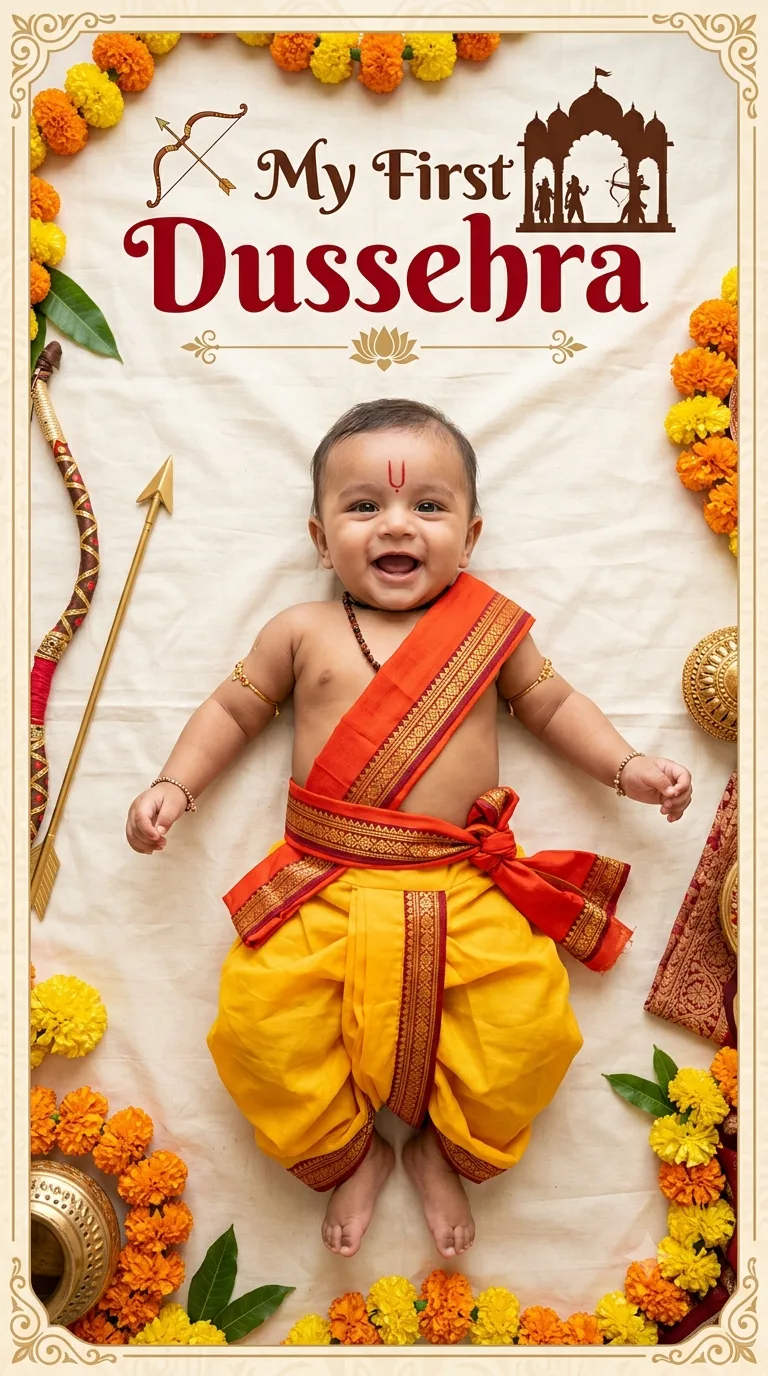
Create Image Baby 2 Months Photoshoot With Rice-Grain Ganesha Artwork using Prompt Seen
- STRICT FACE IDENTITY COPY DNA
Use the uploaded reference image exclusively as the facial identity source for the baby. Directly copy the exact facial identity from the uploaded image, including the exact head shape, forehead, natural hairline, eyebrow structure, eyelids, eye shape and spacing, nose, lips, cheeks, chin, ears, natural skin tone, skin texture, facial proportions, apparent age, and every recognizable facial characteristic. Do not create a similar baby, generic baby face, or inspired facial appearance. Do not beautify, reshape, stylize, age, de-age, or modify the facial features. The uploaded reference is the face identity source only; every other element must be reconstructed from the current visual blueprint.
- VISUAL RECONSTRUCTION DNA
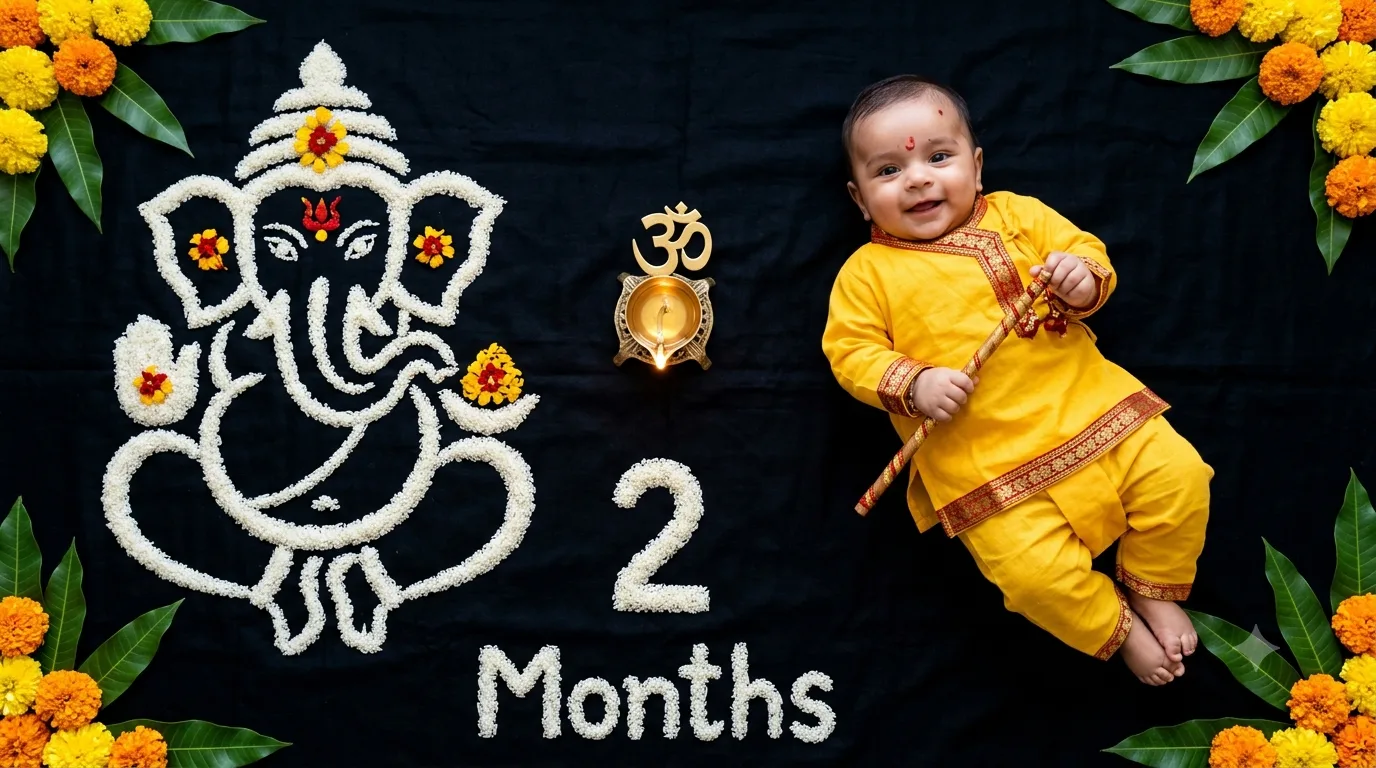
Reconstruct the current reference as a carefully arranged top-down baby milestone flat-lay photograph on a deep black fabric background. The dominant visual concept is a baby positioned on the right side beside a large handcrafted Ganesha artwork made from white rice grains, with additional rice-grain typography, devotional objects, flowers, leaves, and a clearly visible “2 Months” milestone arrangement. The Ganesha artwork is not a printed illustration or digital graphic; it is physically created on the black surface using densely arranged tiny white rice grains, with selected colored floral and decorative accents.
Preserve the exact visual balance between the baby occupying the right half and the large Ganesha grain artwork occupying the left half.
- SUBJECT & COMPOSITION DNA
Place the baby on the right side of the horizontal composition, lying diagonally on the black fabric with the head toward the upper-right and the feet toward the lower-right/lower-middle area. The baby's body occupies roughly the right half of the frame.
Place the large Ganesha grain artwork on the left half, vertically extending from the upper-left toward the lower-left. Below and slightly to the right of the Ganesha artwork is the large milestone “2”, followed by “Months” beneath it. Preserve the spacing between the baby, Ganesha artwork, diya, Om symbol, number, and lettering.
The corners contain small clusters of orange and yellow flowers with green leaves. Preserve these as framing decorations without allowing them to dominate the composition.
- POSE & BODY LANGUAGE DNA
Reconstruct the baby's exact pose from the reference. The baby lies on the back at a slight diagonal angle, with the head raised naturally toward the upper-right. One arm is bent upward holding a decorated stick, while the other arm is bent upward beside the torso with the hand naturally closed. The legs are bent naturally, with the knees and feet positioned toward the lower-right.
Preserve the infant's natural body proportions, limb geometry, hand positions, head orientation, and relaxed expression. Do not convert the baby into a sitting, standing, sleeping, or different lying pose.
- OUTFIT & STYLING DNA
Reconstruct the baby's bright yellow traditional outfit visible in the reference. The baby wears a yellow draped garment with a vivid red-and-gold embroidered border, wrapped naturally around the torso and lower body. Preserve the folds, overlapping fabric, red decorative edging, gold detailing, and realistic textile texture.
The outfit should look physically wrapped and naturally arranged around the baby, with authentic fabric folds and weight. Do not simplify it into a generic yellow costume.
- HEAD & FACIAL MARKING DNA
Preserve the small red devotional marking visible on the baby's forehead exactly as part of the styling. It consists of three small vertical red strokes with a small central red decorative mark beneath them. Reproduce it subtly and naturally on the forehead without enlarging or redesigning it.
- DECORATED STICK DNA
The baby's raised hand holds a slender decorated traditional stick positioned diagonally upward toward the upper-right. Reconstruct the stick with its visible red, yellow, and gold decorative pattern, narrow cylindrical shape, and small hanging decorative detail near its lower end.
Preserve its scale relative to the baby's hand and its exact diagonal orientation. It must look like a real physical decorated stick.
- GANESHA RICE-GRAIN ART DNA
The large Ganesha artwork on the left is the central handcrafted visual element and must be reconstructed with extreme attention to its shape.
Create the entire main Ganesha outline using densely arranged tiny white rice grains placed directly onto the black fabric. The artwork consists of a stylized front-facing Ganesha form with a rounded head, large curved ears, curved trunk, decorative upper head structure, extended arms/body contours, and lower ornamental curves.
The Ganesha should remain an outline/line-art style composition made from rice grains, allowing the black fabric to remain visible inside many of the outlined shapes. Do not turn it into a solid white Ganesha illustration.
Preserve the multiple curved rice-grain lines forming the head ornament and body, the symmetrical large ears, curled trunk, decorative contours, and lower curved lines exactly as visually represented.
- GANESHA DECORATIVE DETAILS DNA
Preserve the visible colored accents within the Ganesha artwork. The central forehead area contains three red vertical decorative marks with a small red central element. Small yellow floral accents appear around the Ganesha design, including yellow flower clusters positioned at selected points along the artwork.
At the top of the Ganesha artwork, preserve the small orange/yellow flower accent sitting above the head structure. Preserve the yellow floral accents around the lower decorative portions as physically placed flowers.
These accents must remain separate physical elements placed alongside or within the rice-grain artwork.
- DEVOTIONAL OBJECT DNA
Between the Ganesha artwork and the baby, preserve the small illuminated diya. It is a round traditional oil lamp with a visible warm flame and decorative reddish/orange appearance.
Directly below the diya is a small circular Om symbol, rendered in a warm golden/orange tone. Preserve its circular form, size, placement, and relationship to the diya.
Do not add additional religious objects that are not visible in this reference.
- MILESTONE NUMBER & TYPOGRAPHY DNA
The milestone text is a major visual component and must be reconstructed exactly.
The visible text reads:
2
Months
The large numeral “2” is constructed from densely arranged small white rice grains, matching the material used for the Ganesha artwork. It sits below the diya and Om symbol. Preserve its curved shape, granular texture, scale, and placement.
Below it, the word “Months” is also physically formed from small white rice grains. Reproduce the exact wording “Months”, with a capital M followed by lowercase onths. Do not change it to “MONTHS,” “MONTH,” “2 MONTHS,” or another wording.
The letters must look individually handcrafted from rice grains rather than digitally typed. Preserve the rounded, slightly irregular handcrafted letter shapes and spacing visible in the reference.
- FLORAL CORNER DECORATION DNA
Preserve the floral framing around the edges of the black fabric. Orange and yellow marigold-like flowers with natural green leaves appear around the upper-left, upper-right, lower-left, and lower-right corners.
Keep the flowers partially entering the frame from the edges, creating a subtle decorative border. Preserve their natural size, color variation, leaf shapes, and physical arrangement.
- LOWER DECORATIVE FLORAL ELEMENT DNA
Near the lower-left area beneath the Ganesha artwork, preserve the small round decorative floral arrangement containing multiple colorful flowers. Keep its circular form and physical flower construction.
Do not redesign this element or replace it with a generic floral bowl.
- BACKGROUND DNA
Use a deep matte black fabric sheet covering the entire flat-lay surface. Preserve subtle natural folds and wrinkles visible across the fabric. The black background must create strong contrast against the white rice grains, yellow outfit, orange/yellow flowers, and red decorative elements.
Do not replace the black fabric with a smooth digital background, black studio floor, marble, paper, or another material.
- CAMERA DNA
Use a perfectly 90-degree overhead camera angle, directly above the complete arrangement. This is a true flat-lay composition. Do not introduce perspective tilt or an eye-level viewpoint.
The camera must capture the entire baby, complete Ganesha artwork, milestone typography, diya, Om symbol, flowers, and surrounding black fabric in one coherent horizontal composition.
- LENS & CAMERA DISTANCE DNA
Use a professional full-frame camera with approximately a 50mm low-distortion lens positioned high enough above the arrangement to capture the complete horizontal scene. Maintain natural baby proportions and preserve the relative scale between the baby and the handcrafted artwork.
- LIGHTING DNA
Use soft, controlled overhead lighting across the flat-lay. The baby should be naturally illuminated with realistic skin highlights and soft shadows. The rice grains should create tiny natural shadows against the black fabric, making the handcrafted artwork visibly tactile.
The diya should have a small warm natural flame glow without overpowering the rest of the scene. Preserve subtle dimensionality in the flowers, rice grains, fabric, and clothing.
- COLOR GRADING & MOOD DNA
Preserve the strong contrast between matte black, white rice grains, bright yellow clothing, red embroidery, orange/yellow flowers, green leaves, and warm devotional accents. The overall mood should feel festive, devotional, joyful, handcrafted, and celebratory while remaining a realistic baby photograph.
Do not apply excessive cinematic grading that changes the natural colors.
- VISUAL DEPTH & MATERIAL DNA
Every decorative element must look physically placed on the black fabric. Individual rice grains should remain subtly distinguishable, especially along the edges of the Ganesha, numeral, and letters.
The Ganesha should have slight grain-height variation and tiny shadows. Flowers should show individual petals and natural volume. The black fabric should retain its folds. The baby's skin, clothing, stick, diya, and all other physical objects should have realistic material properties.
- TEXT & TYPOGRAPHY DNA
Text reconstruction is mandatory and must not be guessed or altered.
The exact visible milestone wording is:
“2”
“Months”
The numeral 2 and the word Months are physically constructed from white rice grains. They are not standard digital typography.
Preserve the exact spelling, capitalization, letter sequence, approximate font-like shape, spacing, alignment, size, and rice-grain material. Do not add punctuation or additional words. Do not reinterpret the text.
- IMAGE QUALITY DNA
Create an ultra-realistic 4K Ultra HD professional baby flat-lay photograph. Render realistic infant skin, fine baby hair, natural fabric texture, embroidered clothing, individual rice grains, flower petals, green leaves, diya flame, metallic/decorative details, and black fabric texture.
The final image should look like an authentic physical photoshoot that was carefully arranged by hand, not a digitally illustrated composition.
- NEGATIVE / EXCLUSION DNA
Do not change the copied facial identity. Do not change the baby's pose, position, clothing colors, Ganesha structure, rice-grain construction, milestone wording, or spatial arrangement. Do not replace rice grains with cotton, beads, sand, paint, petals, digital graphics, or smooth vector shapes. Do not turn the Ganesha into a solid filled illustration. Do not redesign the Ganesha or add extra arms, ornaments, weapons, symbols, or decorative elements that are not visible. Do not change “2 Months” to another wording. Do not add names, dates, captions, logos, or additional text. Remove any social-media username, watermark, interface icon, or platform overlay visible in the supplied reference; these are not part of the photoshoot. Avoid malformed rice lettering, unreadable text, distorted Ganesha anatomy, artificial CGI grains, cartoon styling, excessive shadows, distorted baby anatomy, extra limbs, duplicated objects, or unrealistic materials.
- OUTPUT DNA
The uploaded reference is horizontal, therefore generate strictly in 16:9. Create one ultra-realistic 4K image faithfully reconstructing this exact current reference: the baby positioned on the right in a yellow-and-red traditional outfit, holding the decorated stick, the large front-facing Ganesha line artwork handcrafted from white rice grains occupying the left side, yellow and orange floral accents, diya and Om symbol between the artwork and baby, the rice-grain numeral “2”, the rice-grain word “Months”, floral corner decorations, and the entire arrangement placed on a subtly wrinkled black fabric background. The rice-grain Ganesha artwork, its exact spatial structure, the physical grain material, and the milestone typography are core visual elements and must be reconstructed as carefully as the baby. This current reference is the sole visual source; do not carry forward anything from previous images.