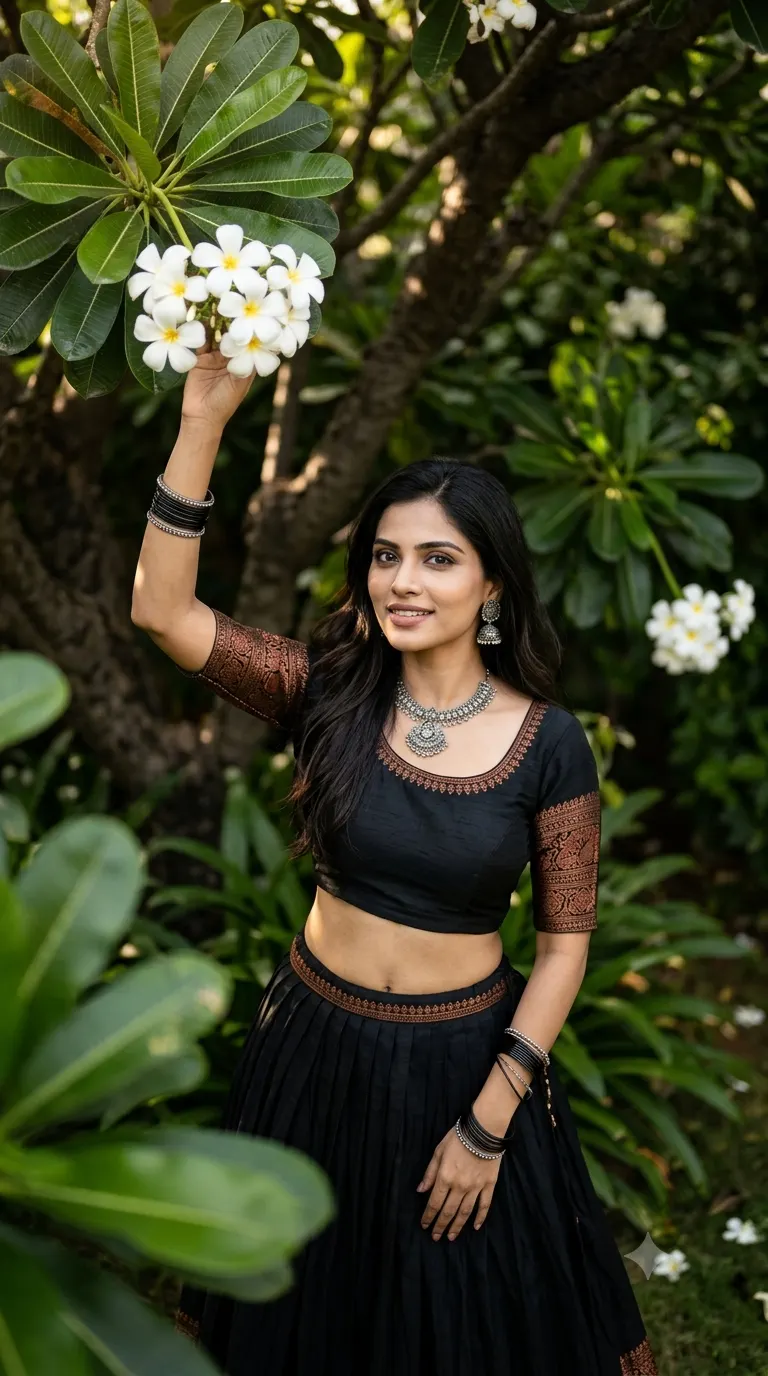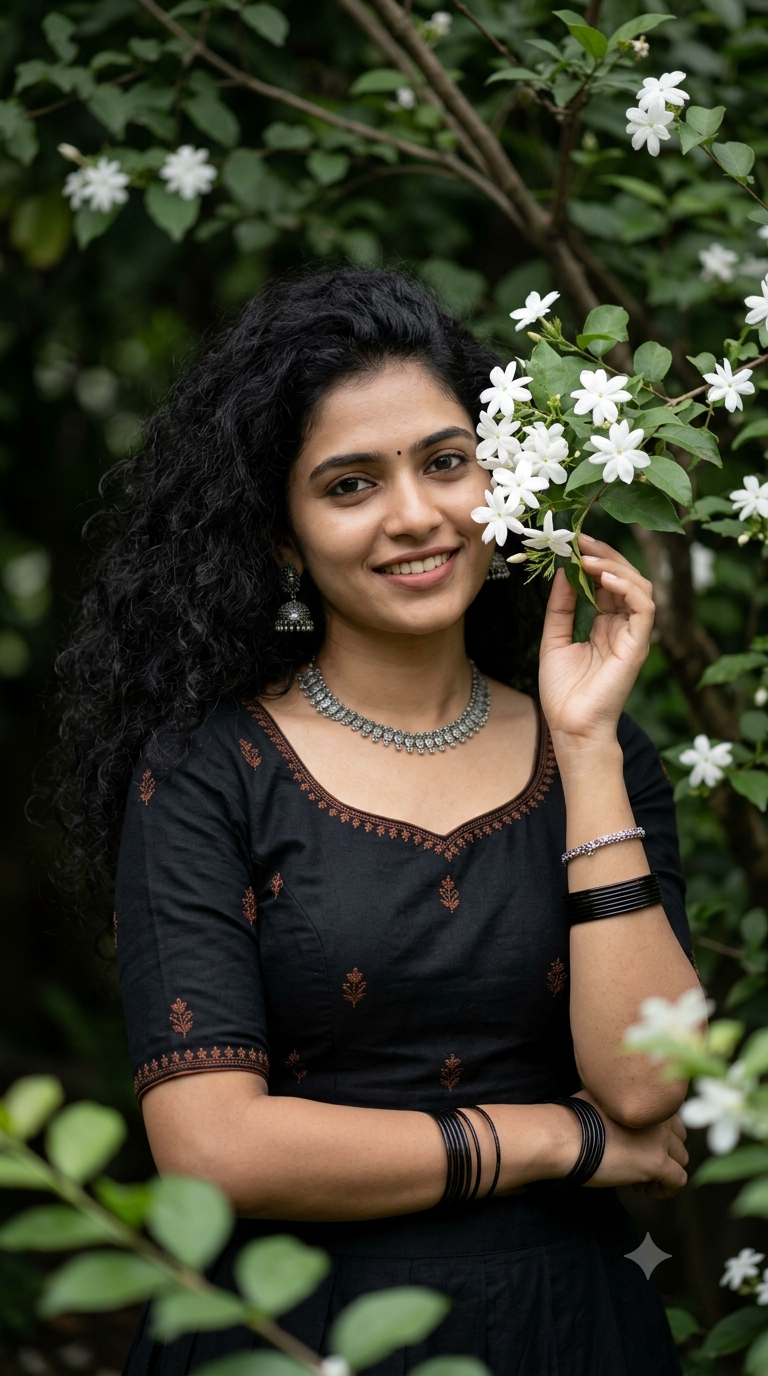
Jasmine Girl Flower Portrait Cahtgpt Prompt
Girls
Create Image Realistic Jasmine Flower Portrait using prompt seen below. 1. STRICT FACE IDENTITY COPY DNA Use the …
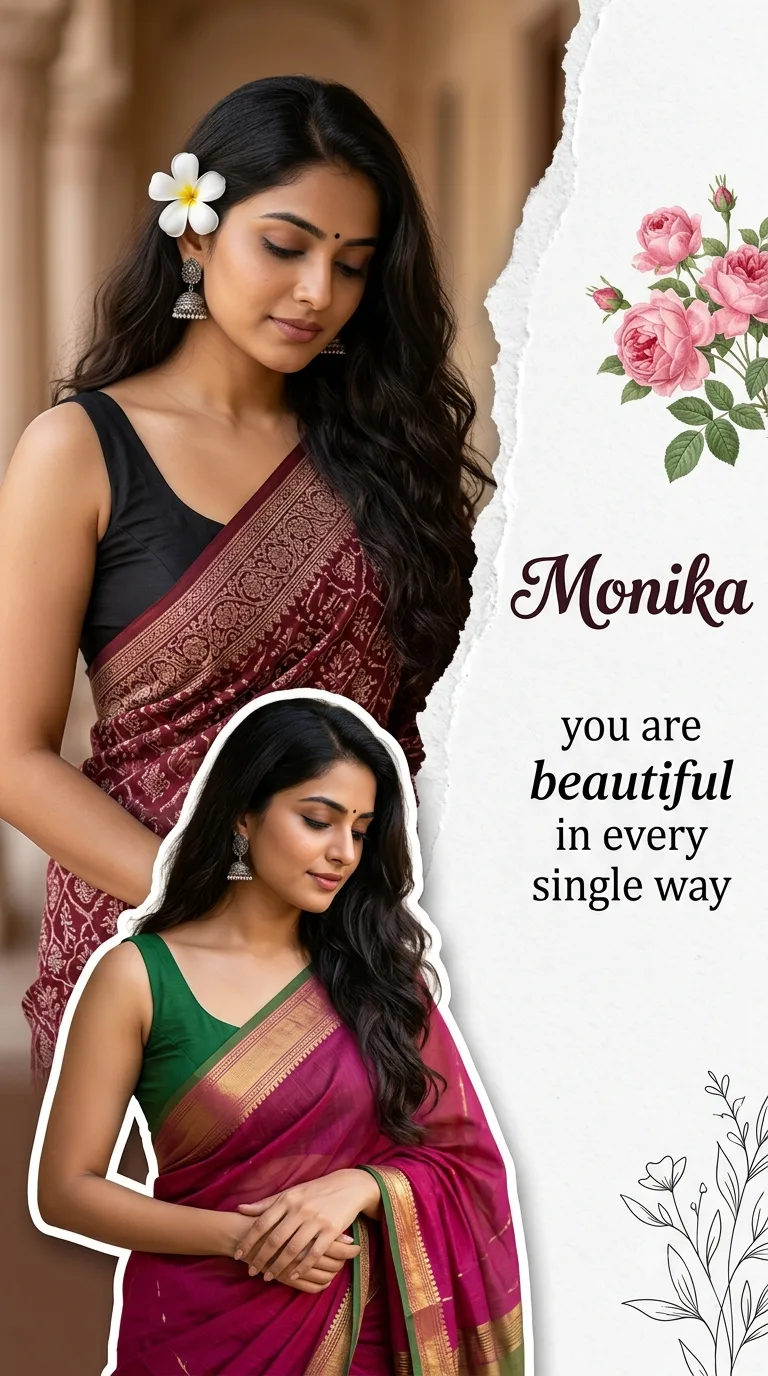
Create Image for Artistic Double-Portrait girl Saree Photography With Torn-Paper Collage using prompt seen below!
Use the uploaded reference image exclusively as the facial identity source for the woman. Directly copy the exact facial identity, including head shape, forehead, natural hairline, eyebrows, eyelids, eye shape and spacing, nose, lips, cheeks, jawline, ears, natural skin tone, skin texture, facial proportions, apparent age, and all recognizable facial characteristics. Do not beautify, reshape, stylize, or modify the facial features. The uploaded image is used only for facial identity; reconstruct all other visual elements from the current reference.
Reconstruct the reference as a sophisticated vertical double-portrait collage featuring the same woman in two different photographic appearances. The upper-left and upper-middle areas contain a large portrait of the woman wearing a maroon patterned saree with a black sleeveless blouse, her eyes lowered and her head gently tilted downward. A smaller foreground portrait overlaps the lower-left and lower-middle areas, showing the woman in a deep pink saree and dark-green sleeveless blouse, also looking downward with a calm expression.
A dramatic torn-paper effect separates the photographic portraits from a textured white paper panel on the right. The torn edge runs irregularly from the upper-right region toward the middle and lower-left, revealing rough, fibrous paper edges. The right panel includes pink roses with green leaves, the name “Monika,” a short beauty quote, and delicate botanical line art.
Preserve the original collage architecture, overlapping portrait layers, paper texture, floral decoration, typography, and restrained editorial aesthetic.
Create a vertical 9:16 composition with two portraits of the same woman.
The larger background portrait occupies most of the upper-left portion, extending from the top edge to approximately the middle-lower region. Her face is positioned in the upper-left quadrant, with long dark hair flowing down the left side and the maroon saree extending diagonally across her torso.
The smaller foreground portrait begins around the center and extends toward the bottom edge. Position her head near the middle-left, with her torso and pink saree continuing downward. This portrait overlaps the larger portrait.
The right third contains a textured white paper panel with a jagged torn edge. Keep the name and quote in the middle-right area, the pink floral arrangement above them, and the botanical illustration near the bottom-right corner.
In the background portrait, the woman stands with her shoulders slightly angled, her head tilted downward, and her eyes gently closed or lowered. Her expression is peaceful, with a subtle smile. Her long hair falls naturally around her face and over her shoulder.
In the foreground portrait, she is shown in a three-quarter side pose, with her face turned slightly downward and toward the right. Her hands rest gently around her lower abdomen, with one hand positioned over the other near the saree drape.
Preserve the graceful posture, lowered gaze, relaxed shoulders, and understated expressions. Do not introduce dramatic poses or direct eye contact with the camera.
Recreate the upper portrait with a black sleeveless blouse and a maroon saree featuring intricate blue, cream, and muted-red woven patterns. The saree drapes diagonally across the chest and shoulder, with a richly patterned border containing small geometric and ornamental motifs.
Her long dark hair is loose, slightly wavy, and parted naturally. Add a small white-and-yellow plumeria flower tucked near the ear on the right side of the image, along with traditional silver jhumka earrings and a small dark bindi.
Preserve the textile's rich patterns, natural folds, and traditional styling.
Recreate the smaller foreground portrait with a deep magenta-pink saree and a dark emerald-green sleeveless blouse. The blouse has a simple rounded neckline and a fitted silhouette.
The saree features a rich pink body with subtle gold motifs and an ornate gold-and-maroon border draped over the shoulder. The fabric falls naturally around the waist and hips, creating soft folds.
Keep the styling elegant and realistic. Do not substitute a lehenga, gown, or unrelated outfit.
Preserve the woman's long, dark, naturally wavy hair in both portraits. In the larger portrait, the hair flows loosely over the left shoulder and down the side of the frame. In the smaller portrait, the hair frames the face and falls over the shoulder in soft waves.
Include the silver traditional earrings in the background portrait, the small bindi, and the white-and-yellow flower. Keep the foreground portrait's jewelry understated, matching the visible reference.
The defining graphic element is a large, irregular ripped white-paper boundary separating the photographs from the right-side text panel.
The torn edge begins near the upper-right edge, curves inward around the upper portrait, then zigzags downward along the right side of the woman's shoulder and across the lower-middle region. The edge has rough, fibrous white paper texture with soft gray shadows that create the illusion of layered paper.
Preserve the irregular natural tear, uneven thickness, and three-dimensional paper edges. The photographic portraits should appear revealed beneath the torn paper rather than placed inside clean rectangular frames.
Do not replace the torn edge with a straight divider, smooth wave, geometric frame, or simple white border.
Create a large white paper surface covering the right portion of the composition. Its texture is subtly fibrous, lightly crumpled, and softly shaded, resembling thick handmade paper.
Keep the panel bright enough for the typography to remain readable, while retaining gentle gray variations around the torn edges.
Do not use a flat digital-white background or introduce colored paper textures.
Position a small botanical arrangement of pink roses in the upper-middle portion of the white panel. Include several roses in different sizes, ranging from pale pink to deeper rose pink, with muted green leaves and slender stems.
The flowers should form a delicate diagonal arrangement, extending slightly downward along the torn-paper edge. Render the petals with realistic layered shapes and soft natural shading.
Keep the flowers confined to the right-side paper panel without obscuring the woman's portraits or the text.
Text is a critical part of this composition and must be reconstructed carefully.
The exact visible text reads:
Monika
Set the name in the middle-right portion of the paper panel, beneath the rose arrangement. Use a decorative handwritten-style font with dark outlines and a lightly textured, elegant appearance.
Keep the name moderately large and horizontally aligned as shown in the reference.
Do not alter the spelling, add a surname, or substitute another name.
Directly beneath “Monika,” reproduce the short quote with its original wording and line arrangement:
you are
beautiful
in every single way
Use delicate black typography. The words “you are” and “in every single way” should appear in smaller, elegant handwritten lettering, while “beautiful” should be larger and more prominent in a clean, refined font.
Maintain the centered alignment within the available right-side panel and preserve the visual hierarchy between the three lines. Keep every word correctly spelled and clearly readable.
Near the lower-right corner, include a delicate botanical illustration consisting of thin brown-gray stems, small leaves, and tiny blossoms.
The illustration should rise diagonally from the lower-right edge toward the center of the paper panel, with fine, elegant lines and a light, understated appearance.
Preserve the sparse composition and subtle contrast. Do not replace the botanical illustration with a large bouquet or colorful floral graphic.
Behind the larger portrait, retain a softly blurred warm beige-brown environment with indistinct architectural shapes. The background should resemble a neutral outdoor or architectural setting, with shallow depth of field and no sharply recognizable objects.
Keep the warm, muted background visible primarily around the upper-left portrait. The foreground portrait and right paper panel should remain visually distinct.
Use a vertical portrait-photography perspective for both photographic layers. The larger portrait is framed from approximately the waist or upper body upward, while the foreground portrait shows the woman from the head down to the lower torso and hips.
Maintain realistic portrait proportions and a natural eye-level perspective within each photographic layer. The collage itself is viewed straight on, like a professionally designed editorial poster.
Use a professional portrait-camera aesthetic with an approximately 50–85mm lens for the photographic portraits. Maintain natural facial proportions, soft background blur, and realistic separation between the woman and the background.
The foreground portrait should be sharp, with detailed hair and saree texture, while the background environment remains softly defocused.
Use soft, warm natural lighting on both portraits. The larger portrait should have gentle illumination across the face, with subtle highlights on the hair, earrings, and patterned saree.
The foreground portrait should feature warm, directional light on the face and arms, with natural shadows around the neckline and folds of the pink saree.
The paper panel should be evenly illuminated, with soft gray shadows along the torn edges to emphasize depth.
Preserve the warm beige, maroon, magenta-pink, emerald green, white, and muted botanical tones.
The mood should feel elegant, feminine, affectionate, and editorial. Keep the photographic portraits natural and lifelike while allowing the torn-paper effect, floral elements, and typography to create a refined personalized collage.
Render the sarees with realistic woven patterns, visible folds, and natural fabric sheen. Hair should contain individual strands, and the rose petals should have layered botanical detail.
The torn paper must show uneven fibers, slight curling, and subtle shadows. The right panel should retain its handmade-paper texture, while the typography and botanical line art remain crisp.
Create an ultra-realistic 4K Ultra HD editorial portrait collage with detailed facial texture, realistic hair, richly patterned sarees, delicate jewelry, lifelike roses, textured torn paper, and sharp, readable typography.
The final image should look like a professionally designed personalized portrait poster combining real photography and physical paper-collage aesthetics.
Do not change the copied facial identity, the two-portrait arrangement, the maroon and pink sarees, or the torn-paper composition. Do not remove the white paper panel, roses, name, quote, or botanical illustration. Do not misspell “Monika” or alter “you are beautiful in every single way.” Avoid duplicated facial features, inconsistent identities between portraits, distorted hands, artificial skin, incorrect saree patterns, straight paper edges, illegible typography, extra text, and excessive decorative elements. Do not reproduce any watermark or interface overlay from the reference.
The uploaded reference is vertical, therefore generate strictly in 9:16. Create one ultra-realistic 4K personalized portrait collage faithfully reconstructing this exact reference: a larger background portrait of a woman in a maroon patterned saree and black blouse, a smaller overlapping foreground portrait in a magenta-pink saree and emerald-green blouse, an irregular torn-paper boundary, pink roses, the name “Monika,” the quote “you are beautiful in every single way,” and delicate botanical line art on a textured white panel.
Preserve the original composition, portrait overlap, outfit colors, torn-paper geometry, floral placement, and exact typography. The current reference is the sole visual blueprint; do not carry forward themes or objects from previous images.
Explore more prompts related to this one.