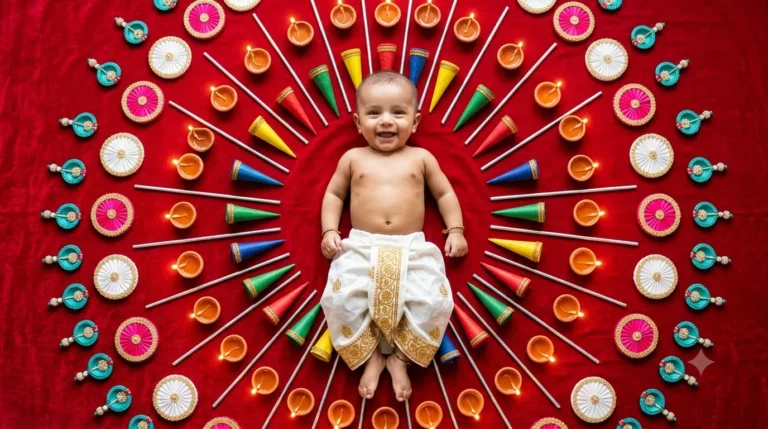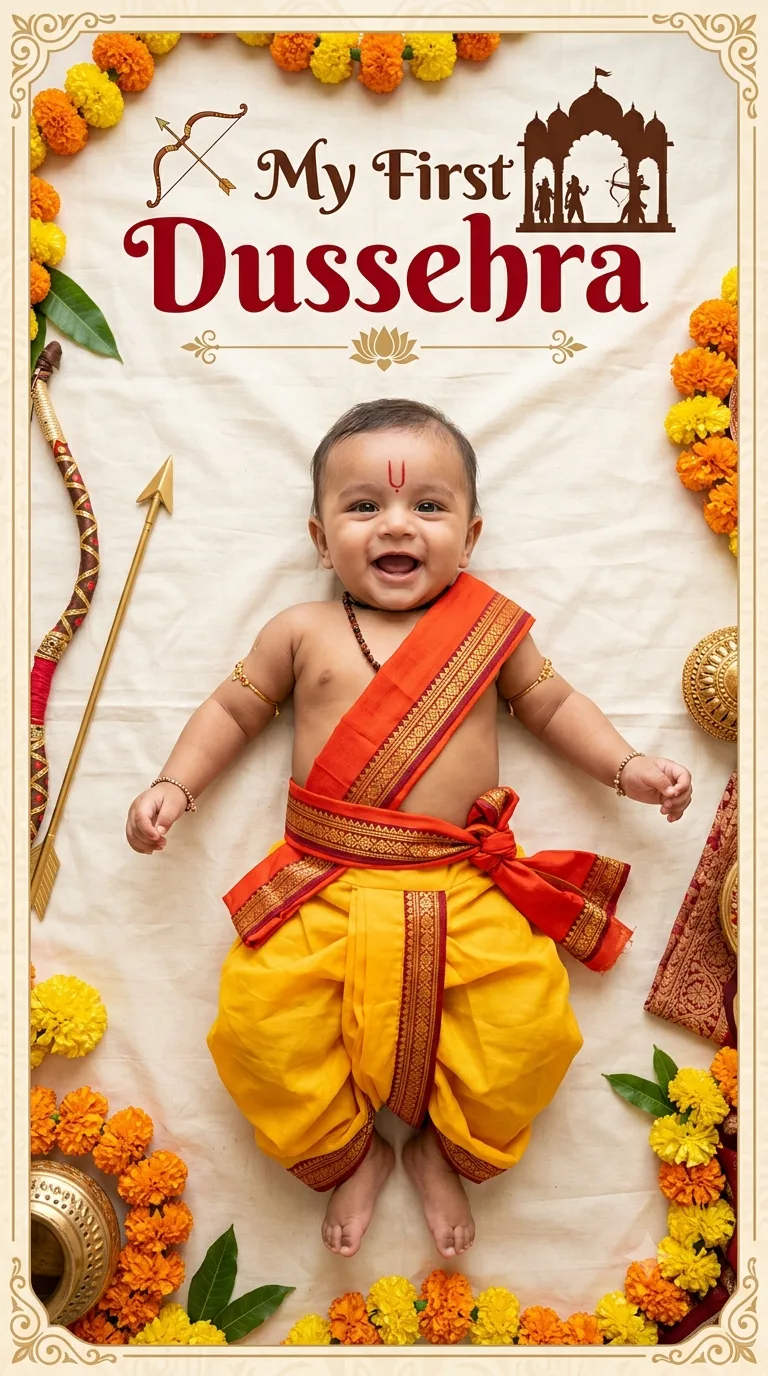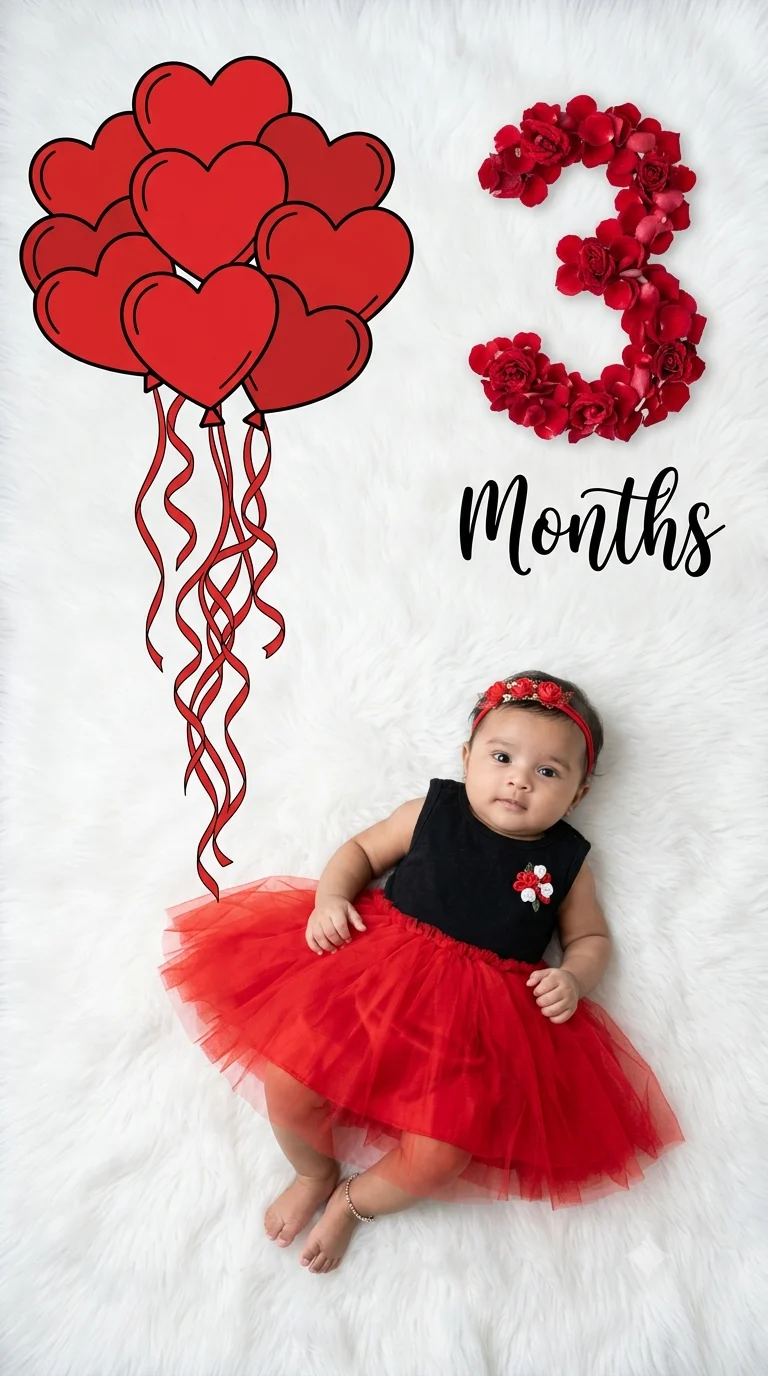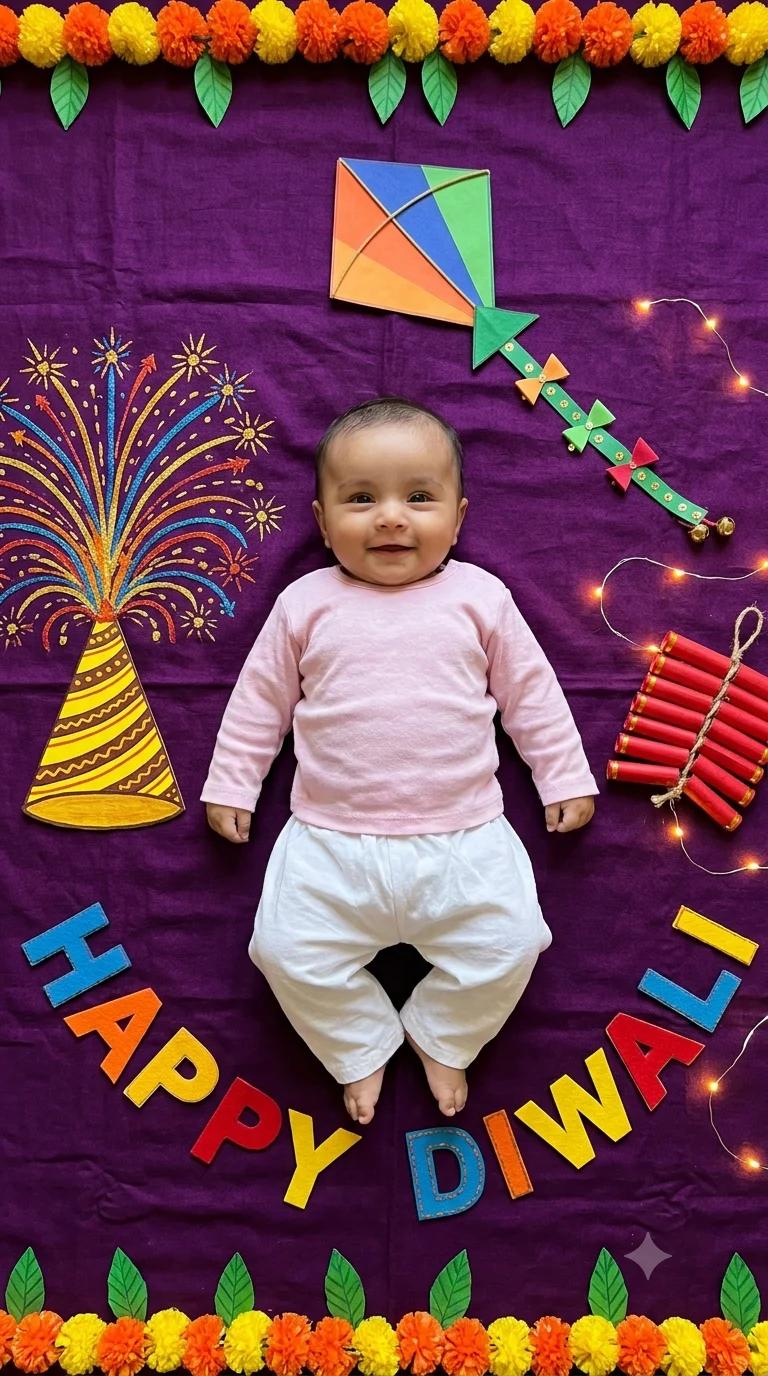
Diwali Photoshoot Baby Boy Gemini Prompt!
Baby
Create Image Colorful Diwali Celebration Baby Photoshoot Prompt STRICT FACE IDENTITY COPY DNA Use the uploaded reference image …
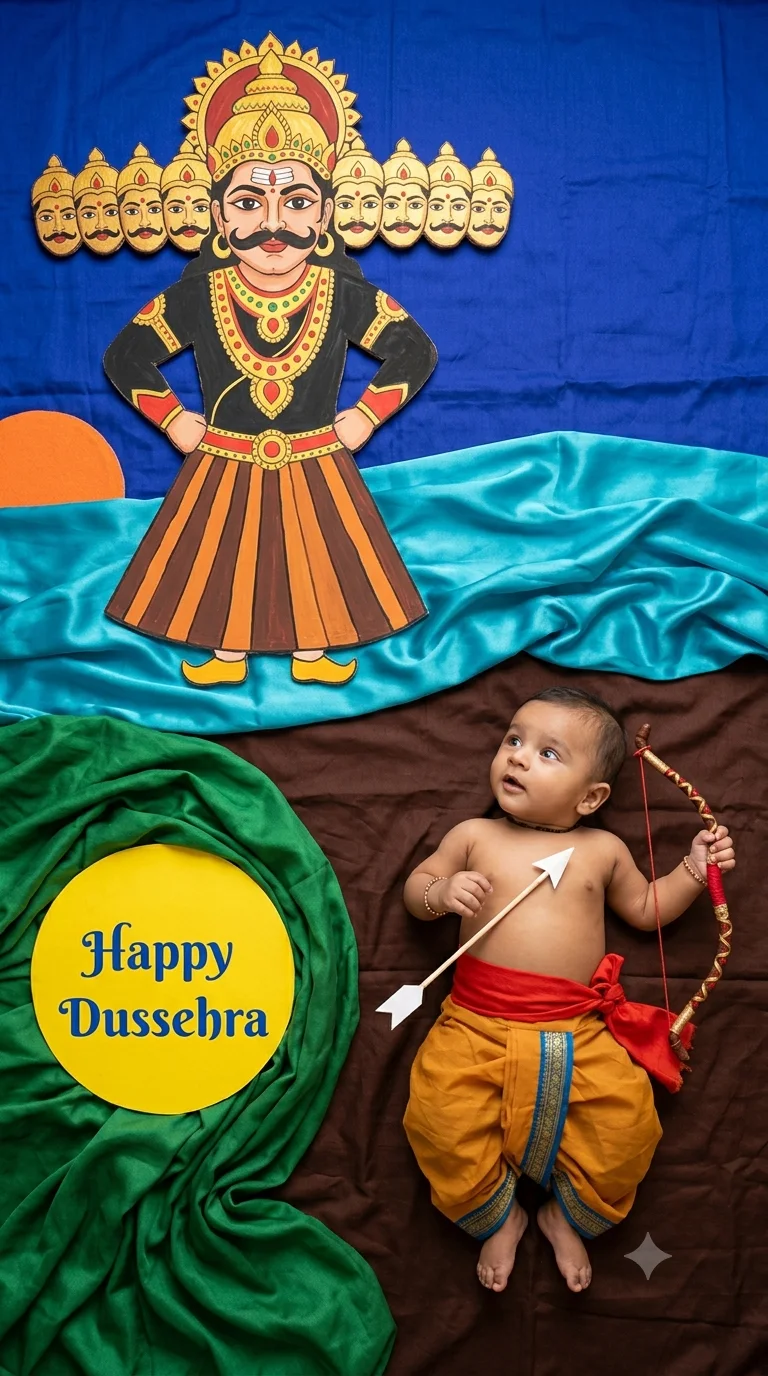
Create Image Baby Dussehra Photoshoot With Ravana Effigy and Lord Rama-Inspired Props using prompt seen below.
Use the uploaded reference image exclusively as the facial identity source for the baby. Directly copy the exact facial identity, including head shape, forehead, natural hairline, eyebrows, eyelids, eye shape and spacing, nose, lips, cheeks, chin, ears, natural skin tone, skin texture, facial proportions, apparent age, and every recognizable facial characteristic. Do not beautify, reshape, stylize, or modify the facial features. Use the uploaded image only for facial identity; reconstruct every other visual element from the current reference.
Reconstruct the reference as a traditional Dussehra-themed baby photoshoot arranged on layered fabrics. The baby lies in the lower-right portion of the frame, wearing a mustard-orange dhoti with a bright-red waist sash. The baby holds a small traditional bow while looking upward toward a large handcrafted Ravana effigy positioned in the upper-left.
The Ravana figure is a flat, colorful cutout with a black upper garment, a long flared skirt featuring vertical brown and orange stripes, a decorative crown, and multiple small golden faces arranged in a horizontal row behind the main head. A flowing turquoise-blue fabric forms the middle background, separating the royal-blue upper backdrop from the dark-brown foreground fabric.
At the lower-left, a large yellow circular sign contains the exact greeting “Happy Dussehra” in blue cursive lettering. Green fabric is gathered into soft folds at the bottom-left, and a small orange semicircular prop appears behind the Ravana figure.
Preserve the handmade festive set, layered textile arrangement, Ravana cutout, baby placement, bow-and-arrow props, and greeting sign.
Create a vertical 9:16 composition with the baby positioned in the lower-right quadrant. The baby's head is near the center-right, with the torso and bent legs extending toward the bottom edge.
Place the Ravana effigy prominently in the upper-left and upper-middle area. Its crown and multiple heads occupy the upper third, while the flared skirt extends toward the center-left.
Stretch turquoise-blue fabric horizontally across the middle of the image, forming a wavy boundary between the blue upper backdrop and brown lower surface.
Place the yellow circular greeting sign in the lower-left quadrant. Arrange folded green fabric in the extreme bottom-left corner, and retain the orange semicircle behind the effigy on the left.
Maintain clear separation between the baby, the Ravana figure, and the greeting sign.
Reconstruct the baby lying on the back at a diagonal, with the head turned toward the upper-left and the eyes looking curiously at the Ravana effigy.
The baby's right arm, on the image's left side, is bent toward the chest and holds a small white arrow. The other hand grips a miniature curved brown bow positioned beside the baby's head and shoulder.
The legs are bent naturally, with the feet visible near the lower edge. Preserve realistic infant proportions and the curious upward gaze.
Recreate a traditional mustard-orange dhoti wrapped around the baby's lower body. The fabric is gathered at the waist and features a narrow blue-and-gold decorative border running down the front.
Add a vivid red sash tied around the waist, with one loose end extending toward the baby's side. Keep the upper torso bare, as shown in the reference.
Do not add a shirt, jacket, crown, or unrelated clothing accessories.
Reconstruct a large, handcrafted, flat Ravana effigy standing in the upper-left region.
The figure has a prominent central face with a thick black moustache, expressive eyes, a decorated forehead, and an elaborate gold-and-red crown. A row of multiple smaller golden faces extends horizontally behind the main head, forming Ravana's characteristic many-headed silhouette.
The body wears a black short-sleeved upper garment decorated with red and gold borders, a large round gold-and-red necklace ornament, and a belt around the waist. The lower garment is a broad, flared skirt with alternating vertical dark-brown and orange stripes.
Position the arms akimbo, with both hands resting at the waist. Include small yellow feet and a flat cutout-style silhouette.
Preserve the handcrafted, painted-cardboard appearance. Do not turn Ravana into a realistic human, a three-dimensional statue, or a cartoon character with exaggerated proportions.
Place a small traditional brown bow in the baby's hand on the right side of the composition. The bow curves upward beside the baby's head and shoulder, with a thin red bowstring connecting its ends.
Include a small white arrow with a pointed triangular tip near the baby's chest, angled diagonally toward the upper-left. Keep the arrow lightweight and prop-like, with a simple white shaft and visible arrowhead.
Maintain realistic scale relative to the baby's hands and body.
Create a wide strip of shiny turquoise-blue satin fabric extending horizontally across the middle of the frame.
The fabric forms several loose, flowing waves, with glossy highlights along the raised folds and deep blue shadows in the creases. Its lower edge overlaps the dark-brown fabric, while the upper edge separates it from the royal-blue backdrop.
Preserve the strong horizontal flow and irregular fabric folds. Do not replace the fabric with water, a painted wave, or a digitally generated ribbon.
The upper background is deep royal-blue fabric with visible wrinkles and subtle horizontal folds.
The lower background is dark chocolate-brown fabric, extending behind the baby and the yellow greeting sign. Preserve the natural textile creases and slightly uneven surface.
At the lower-left, arrange a large piece of rich green fabric with deep folds and overlapping edges. Behind the Ravana figure on the left, retain a partially visible orange semicircular prop.
Place a large, bright-yellow circular sign in the lower-left quadrant, partly surrounded by the green fabric.
The sign must contain the exact wording:
Happy
Dussehra
Use elegant blue cursive lettering, with “Happy” on the first line and “Dussehra” directly below. Maintain the handwritten appearance, centered alignment, and generous spacing within the circular shape.
Do not misspell the greeting, change its wording, or use ordinary bold sans-serif typography. The yellow circle should remain a solid, clean decorative element.
Use a slightly elevated, near-overhead camera angle that captures the entire baby and the full handmade set. The camera looks down sufficiently to show the baby's face, clothing, bow, and arrow while retaining the upright appearance of the Ravana cutout.
Preserve the layered depth of the backdrop, the horizontal turquoise fabric, and the relative positioning of the props.
Use a professional camera with an approximately 50mm low-distortion lens. Frame the complete vertical arrangement, including Ravana's crown, the full skirt, the baby's feet, the greeting sign, and the green fabric.
Keep the baby and Ravana figure sharply visible, with realistic proportions and no unnecessary cropping.
Use soft, even studio lighting that reveals the baby's natural skin texture and the textile details. The turquoise satin should show glossy highlights, while the brown and blue fabrics retain visible folds.
Illuminate the Ravana effigy evenly so its multiple faces, crown, necklace, and striped skirt remain distinct. Avoid harsh shadows or overexposed yellow and red colors.
Preserve the dominant royal blue, turquoise, dark brown, mustard orange, vivid red, golden yellow, and rich green colors.
The mood should feel festive, playful, traditional, and handcrafted. Keep the set visually rich without making it overly polished or artificial.
Render the Ravana figure as painted, flat cutout artwork, the turquoise layer as glossy satin, the upper and lower backdrops as wrinkled fabric, and the green foreground as soft gathered cloth.
Keep the yellow greeting sign clean and circular. The baby's clothing should show realistic fabric folds, and the bow and arrow should resemble small physical props.
Create an ultra-realistic 4K Ultra HD professional baby Dussehra photoshoot, with natural skin texture, detailed fabric folds, crisp handcrafted artwork, readable greeting text, and realistic studio lighting.
The final image should resemble a real festive photoshoot built from physical fabric, cardboard artwork, and decorative props.
Do not change the baby's facial identity, curious expression, lying pose, mustard-orange dhoti, red sash, bow, or arrow. Do not remove or redesign Ravana's multiple heads, crown, black upper garment, or vertically striped skirt. Preserve the turquoise fabric wave, blue upper backdrop, brown lower backdrop, yellow circular sign, green fabric, and orange semicircle. Do not misspell “Happy Dussehra.” Avoid extra limbs, distorted hands, malformed Ravana faces, incorrect head count, floating props, cartoonish three-dimensional figures, excessive decoration, and CGI-like textures. Do not reproduce any watermark or promotional overlay from the reference.
The uploaded reference is vertical, therefore generate strictly in 9:16. Create one ultra-realistic 4K image faithfully reconstructing this Dussehra photoshoot: a baby lying in the lower-right wearing a mustard-orange dhoti and red sash, holding a small bow and arrow while looking toward a handcrafted, multi-headed Ravana effigy in the upper-left.
Preserve the royal-blue fabric backdrop, flowing turquoise satin divider, chocolate-brown foreground, yellow circular sign reading “Happy Dussehra” in blue cursive, green fabric folds, and orange semicircular prop.
The current reference is the sole visual blueprint. Preserve its composition, materials, colors, text, and prop placement without carrying forward themes or objects from previous images.
Explore more prompts related to this one.