
A baby’s first month is a beautiful milestone that deserves to be captured in a simple, meaningful, and creative way. A one month baby photoshoot can be more than a traditional portrait—it can use flowers, grains, soft fabrics, handmade numbers, and playful props to create a memorable visual story. These ideas are designed to inspire parents looking for one month baby photoshoot ideas, newborn milestone setups, and creative Gemini AI photo prompts that can be recreated at home or adapted for professional photography.
The first month can be represented beautifully through handcrafted milestone arrangements. From a baby lying beside a teddy bear made from lentils and grains to a floral number-one setup, each concept gives the photograph a clear sense of the occasion. Natural materials such as marigold flowers, pulses, rice, leaves, and textured fabrics can make the composition feel warm and personal while keeping the baby as the central focus.
Another charming approach is to create a playful visual journey using a small decorative ladder. The baby can be photographed in a comfortable white outfit while floral numbers mark the milestone above and below the setup. Soft cream backgrounds, tiny white flowers, greenery, and warm marigold tones create a gentle newborn photography aesthetic without making the scene overly complicated.
One Month Baby Photo Prompt
The following one month baby photoshoot collection brings together different creative ways to celebrate the first-month milestone. Each setup uses a distinct visual idea from handcrafted grain artwork and teddy-bear designs to floral numbers and ladder compositions so parents can choose a style that matches their preferred colors, traditions, and photography space.
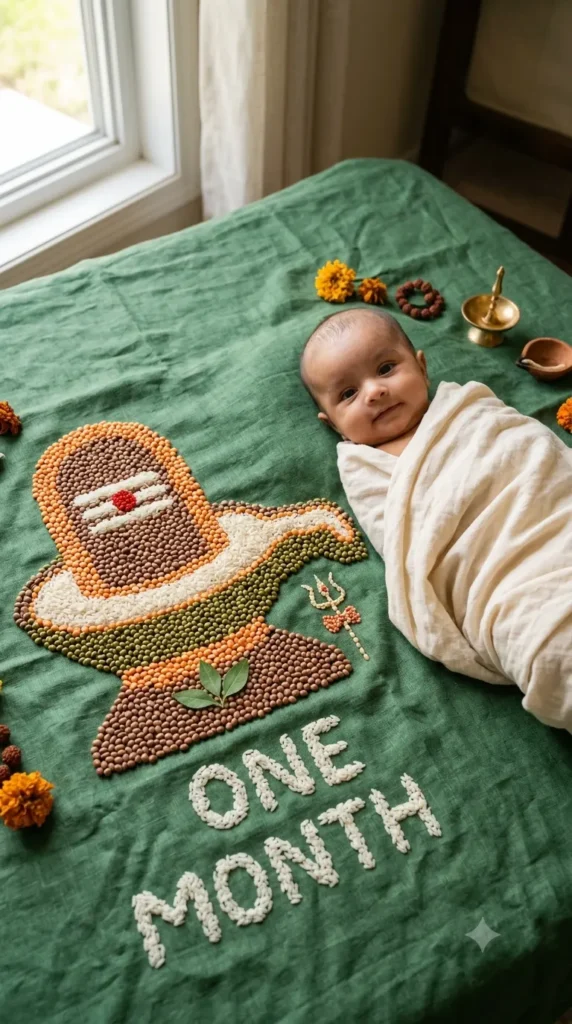
One Month Baby Photoshoot With Shivling
1. STRICT FACE IDENTITY COPY DNA
Use the uploaded reference image exclusively as the facial identity source for the baby. Directly copy the exact facial identity of the baby from the uploaded image into the generated image, including the exact head shape, forehead, hairline, eyebrows, eyelids, eye shape and spacing, iris appearance, nose, lips, cheeks, chin, ears, natural skin tone, skin texture, facial proportions, apparent age, and recognizable facial characteristics. Do not create a similar face, face inspired by the reference, or generic baby face. Do not beautify, reshape, enlarge the eyes, modify the nose, change the age, or stylize the facial features. The uploaded image is used only for exact facial identity copying; everything else must be reconstructed from the reference image.
2. VISUAL RECONSTRUCTION DNA
Reconstruct the reference as a one-month baby milestone photoshoot featuring a baby positioned beside a large handcrafted Shivling-inspired grain artwork. The dominant visual idea is the physical construction of the devotional form from densely arranged tiny white grains or rice-like material on a dark green fabric background. The baby is positioned on the right side, facing the handcrafted Shivling on the left, creating an intimate side-facing interaction. The composition also includes a small traditional damru near the baby, white flowers and green leaves around the lower portion, and the milestone text “ONE MONTH” formed from white grains.
3. SUBJECT & COMPOSITION DNA
Place the baby on the right half of the vertical composition, standing or supported upright beside the large grain-art Shivling. Place the Shivling prominently on the left half and make it substantially larger than the baby. Preserve the visual relationship between the two subjects: the baby’s face and hands are oriented toward the Shivling, while the Shivling remains the primary decorative structure. Position the milestone text horizontally across the lower-middle portion beneath the main subjects, with floral decoration below it. Maintain the dark green negative space surrounding the arrangement.
4. POSE & BODY LANGUAGE DNA
Reproduce the baby in a natural upright side-facing pose, with the baby’s body oriented toward the Shivling. The baby’s head is turned toward the left, with the face close to the devotional form. One arm is bent forward with the hand positioned near the face, while the other hand is also raised naturally in front of the body. Preserve the baby’s relaxed infant posture, slightly curved back, naturally bent legs, bare feet, and authentic newborn body proportions. Do not make the baby pose like an adult or deliberately imitate a formal devotional posture.
5. OUTFIT & STYLING DNA
Reconstruct the baby wearing a simple mustard-yellow/orange traditional cloth wrapped around the lower body, leaving the upper body naturally bare as visible in the reference. Preserve the loose, soft folds of the fabric and its slightly irregular hand-wrapped appearance. Do not add a shirt, modern clothing, jewelry, crown, or additional costume elements that are not visible in the reference. Keep the styling simple so the handcrafted Shivling remains visually dominant.
6. SHIVLING GRAIN-ART DNA
Reconstruct the large Shivling-like devotional form on the left using densely packed small white grains or rice-like natural particles. The central rounded vertical Shivling rises from a broad layered circular base, with the surrounding yoni-like platform extending toward the right. Preserve the thick, textured three-dimensional appearance created by thousands of closely arranged white grains. The entire structure should look physically assembled grain-by-grain directly on the dark green fabric, with individual grains visibly distinguishable rather than appearing as smooth plaster, clay, plastic, or a digitally rendered object.
7. SHIVLING DETAILS & MATERIAL DNA
Preserve the visible horizontal decorative markings across the front of the upper Shivling section using pale grain material, with a small red circular element centered between the markings. Preserve the green leaf arrangement placed on the lower front section of the base. Keep the layered circular base clearly defined through stacked rings of white grain material. The edges should remain naturally irregular, showing the handcrafted construction rather than mathematically perfect digital geometry.
8. PROPS & FLORAL DECORATION DNA
Include the small traditional damru visible beside the baby toward the right side of the Shivling, positioned around the baby’s upper-body level. Reconstruct it as a physical miniature drum with a wooden or warm-colored central body and crisscrossed cord/string detailing. Around the lower-left and lower-center portions, place small white five-petaled flowers and fresh green leaves exactly in the decorative style visible in the reference. Keep the floral elements sparse and naturally scattered rather than filling the entire background.
9. BACKGROUND DNA
Use a deep dark forest-green fabric as the entire background and floor surface. Preserve the visible soft folds, wrinkles, and uneven fabric texture. The dark green surface should provide strong contrast against the white grain artwork, white flowers, and pale milestone lettering. Do not replace the fabric with a studio wall, wooden floor, temple background, outdoor scenery, or another colored backdrop.
10. TEXT & TYPOGRAPHY DNA
Reproduce the exact visible milestone text “ONE MONTH” in uppercase English. The words must be physically constructed from individually arranged small white grains or rice-like particles, matching the material used for the Shivling artwork. Place the text horizontally across the lower portion of the image beneath the baby and Shivling. Preserve the exact spelling, capitalization, spacing, and two-word wording. The letters should have an organic handcrafted texture with visible individual grains and slightly irregular edges. Do not use digital typography, smooth printed lettering, Hindi text, “1 MONTH,” “ONE MONTH OLD,” or any additional wording.
11. CAMERA DNA
Use a straight-on, slightly elevated baby-portrait camera angle that captures the baby and Shivling from approximately the same frontal side perspective as the reference. Keep the camera sufficiently far away to include the entire Shivling, complete baby body, milestone text, flowers, leaves, and surrounding dark-green fabric. Preserve the strong vertical composition and the left-right relationship between the Shivling and baby. Do not use an overhead flat-lay angle because the reference is photographed from the side/front.
12. LENS & CAMERA DISTANCE DNA
Simulate a professional full-frame camera using approximately a 50mm portrait lens positioned around 2.5–3 metres from the subjects. Maintain natural baby proportions and avoid wide-angle distortion. Use approximately f/4–f/5.6, keeping the baby and main grain artwork sharply detailed while allowing the distant fabric background to remain subtly softer. Preserve enough depth of field for the “ONE MONTH” lettering and floral decorations to remain readable and recognizable.
13. LIGHTING DNA
Use soft, diffused frontal lighting with gentle illumination falling across the baby’s face, bare skin, yellow cloth, white grain artwork, and flowers. Maintain subtle dimensional shadows between the layers of the grain Shivling so its physical construction remains visible. The dark green fabric should remain deep and rich without becoming completely black. Avoid harsh flash, dramatic colored lighting, excessive glow, or theatrical illumination.
14. COLOR GRADING & MOOD DNA
Preserve the reference palette of deep forest green, warm white, natural baby skin tones, mustard yellow/orange cloth, small red accent, fresh green leaves, and white flowers. The mood should feel peaceful, innocent, devotional, handcrafted, and intimate. Keep the colors realistic and moderately saturated. Do not introduce neon colors, cinematic teal-orange grading, excessive HDR, or artificial color effects.
15. IMAGE QUALITY DNA
Create an ultra-realistic 4K Ultra HD professional baby milestone photograph. Show realistic infant skin texture, fine baby hair, natural fabric folds, authentic grain surfaces, individual rice/grain particles, woven-looking background fabric, realistic flower petals, natural leaves, and physically believable damru construction. The Shivling and lettering must clearly look handcrafted from thousands of individually placed grains rather than computer-generated smooth shapes.
16. NEGATIVE / EXCLUSION DNA
Do not change the copied facial identity. Do not replace the baby with a generic infant. Do not turn the Shivling into a stone statue, metallic object, painted illustration, digital graphic, or smooth sculpture. Do not replace the white grain material with flowers unless the reference visibly contains flowers in that particular element. Do not remove the layered Shivling base, horizontal markings, red central detail, green leaves, damru, white flowers, or grain-built lettering. Do not change “ONE MONTH” into different text. Avoid extra people, temple architecture, religious statues, excessive decorations, modern props, malformed baby anatomy, unnatural limbs, artificial skin, smooth CGI grains, incorrect text, and creative redesign of the reference.
17. OUTPUT DNA
Generate one ultra-realistic 4K Ultra HD image in a strict vertical 9:16 aspect ratio, faithfully reconstructing the supplied reference as a one-month baby milestone photoshoot. Preserve the directly copied baby facial identity, natural upright side-facing pose, mustard-yellow/orange lower-body cloth, large handcrafted white-grain Shivling with layered base and visible decorative details, miniature damru, white flowers, green leaves, deep forest-green wrinkled fabric background, and the exact physically constructed “ONE MONTH” lettering made from white grains. The reference image remains the primary source of truth for composition, proportions, materials, placement, camera geometry, lighting, and overall visual appearance.
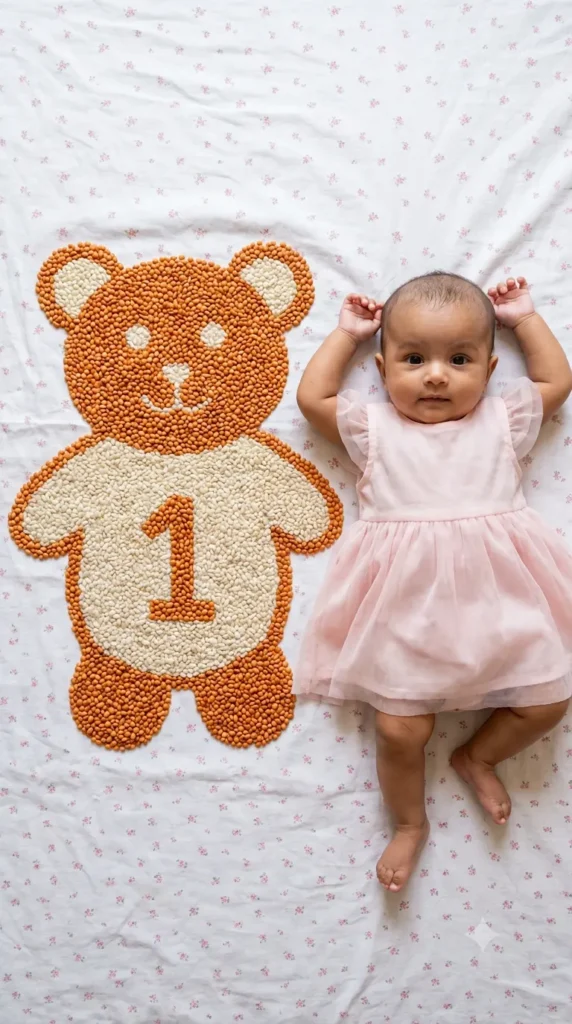
One Month Baby Photoshoot With Teddy Bear Milestone
1. STRICT FACE IDENTITY COPY DNA
Use the uploaded reference image exclusively as the facial identity source for the baby. Directly copy the exact facial identity of the baby from the uploaded image into the generated image, including the exact head shape, forehead, hairline, eyebrows, eyelids, eye shape and spacing, iris appearance, nose, lips, cheeks, chin, ears, natural skin tone, skin texture, facial proportions, apparent age, and recognizable facial characteristics. Do not create a similar face, a face inspired by the reference, or a generic baby face. Do not beautify, reshape, enlarge the eyes, modify the nose, change the age, or stylize the facial features. The uploaded image is used only for exact facial identity copying; everything else must be reconstructed from the reference.
2. VISUAL RECONSTRUCTION DNA
Reconstruct the reference as a top-down baby milestone photoshoot in which the baby lies beside a large handcrafted teddy-bear-shaped artwork made entirely from grains and lentils. The defining visual concept is the physical grain arrangement: the teddy bear is constructed directly on the white floral bedsheet using different natural grains to create its body, face, eyes, outline, ears, and internal details. A clearly recognizable number “1” is physically formed inside the teddy bear’s body using orange-brown grains. The baby lies naturally to the right of this grain-art figure, creating a balanced horizontal composition.
3. SUBJECT & COMPOSITION DNA
Place the baby on the right half of the frame, lying on their back with the head toward the upper-right and legs extending toward the lower-right. Place the large teddy-bear grain artwork on the left half, approximately the same overall height as the baby. Preserve the close side-by-side relationship between the baby and the handcrafted figure. The teddy bear should occupy the left-center area without overlapping the baby. Maintain the reference’s generous white bedsheet background around both subjects.
4. POSE & BODY LANGUAGE DNA
Reproduce the baby lying naturally on their back with both arms raised and bent beside the head. One hand rests near the upper side of the head while the other arm is similarly raised. Keep the legs naturally separated, with one leg extending downward and the other slightly angled. Preserve the relaxed infant body posture and natural proportions. The baby should look directly toward the camera because the camera is positioned overhead.
5. OUTFIT & STYLING DNA
Dress the baby in the same soft light-pink baby dress visible in the reference. Recreate the translucent layered short sleeves, delicate floral embroidery or tiny white decorative motifs across the fabric, fitted upper section, gathered skirt, and prominent small pink bow at the waist. Preserve the soft pastel-pink color and lightweight fabric appearance. Do not replace the dress with another outfit or introduce additional accessories that are not visible in the reference.
6. TEDDY BEAR GRAIN-ART DNA
Construct a large simplified teddy-bear silhouette entirely from physical grains. The bear has a large rounded orange-brown grain-filled head, two rounded ears, a broad white grain-filled body, short rounded arms, and two rounded legs. Surround the teddy bear with a clearly defined orange-brown grain border. The ears contain pale white grains inside their orange-brown outlines. Create two small circular white grain areas for the eyes. Preserve the simple handcrafted facial appearance and the strong contrast between orange-brown and pale grains.
7. NUMBER “1” MATERIAL DNA
Inside the teddy bear’s white body, reproduce a clearly recognizable number “1” made physically from the same orange-brown grains used for the bear’s outline. The numeral must be centered vertically within the bear’s torso and remain clearly separated from the surrounding white grains. The number should look individually arranged from real lentils, pulses, seeds, or grains, with tiny natural variations in size, shape, orientation, and color. Do not render the “1” as digital typography, painted text, printed graphics, or a smooth computer-generated shape.
8. MATERIAL & SURFACE DNA
The grain artwork must visibly consist of hundreds of individually placed natural grains or pulses. Preserve their real irregular shapes, subtle color differences, tiny gaps, overlapping areas, and three-dimensional texture. The orange-brown material should resemble small lentils or pulses, while the pale areas should resemble uncooked white rice or another light-colored grain. The artwork must appear physically handcrafted directly on the bedsheet rather than digitally composited.
9. ENVIRONMENT / BACKGROUND DNA
Use the same soft white bedsheet as the entire background. Preserve its subtle wrinkles and the delicate tiny pink floral print visible throughout the fabric. Keep the bedsheet clean and uncluttered so the baby and grain artwork remain the dominant elements. Do not introduce furniture, studio props, walls, baskets, toys, balloons, or additional decorations.
10. CAMERA DNA
Use a perfectly overhead 90-degree top-down camera angle, looking directly down at the baby and grain artwork. Keep the camera centered over the complete composition so the baby and teddy bear appear naturally proportioned and undistorted. Preserve the reference’s flat-lay photographic geometry and side-by-side arrangement.
11. LENS & CAMERA DISTANCE DNA
Simulate a professional full-frame camera using approximately a 50mm lens mounted directly overhead at sufficient height to capture the entire baby and teddy-bear artwork comfortably within the frame. Avoid wide-angle distortion. Maintain sharp detail across the baby, clothing, grains, bedsheet texture, and handcrafted artwork. Use approximately f/5.6–f/8 so the entire flat-lay arrangement remains clearly focused.
12. LIGHTING DNA
Use soft, evenly diffused natural-looking overhead lighting. Illuminate the baby and grain artwork uniformly without harsh shadows. Preserve subtle shadows underneath individual grains and around the baby’s body so the physical depth of the arrangement remains visible. Maintain soft highlights on the pink dress and natural tonal variation across the grains. Avoid dramatic studio lighting or strong directional shadows.
13. COLOR GRADING & MOOD DNA
Preserve the reference’s soft, natural, baby-photography palette: clean white, pale pink, warm orange-brown, cream, and subtle floral pink accents. Keep the image bright, gentle, innocent, warm, and minimal. Avoid excessive saturation, cinematic color grading, artificial HDR, neon colors, or dramatic contrast.
14. IMAGE QUALITY DNA
Create an ultra-realistic 4K Ultra HD professional baby flat-lay photograph. Show authentic infant skin texture, fine natural hair, realistic fabric fibers, individual grains, tiny lentils, natural bedsheet wrinkles, and physically believable contact between the baby and surface. The grain artwork must have genuine handcrafted texture and dimensionality. Avoid CGI-looking grains, plastic textures, illustration styles, or digitally perfect repeated patterns.
15. NEGATIVE / EXCLUSION DNA
Do not change the copied facial identity. Do not replace the baby with a generic infant. Do not redesign the teddy bear into another animal or character. Do not replace the grains with flowers, beads, fabric, paper, paint, or digital graphics. Do not change the number “1” into another number or omit it. Do not turn the number into typed typography. Do not add text, milestone labels, toys, balloons, baskets, props, furniture, or unrelated decorations. Avoid distorted baby anatomy, incorrect hands or feet, unnatural pose, oversized teddy bear, excessive shadows, perspective distortion, artificial grain textures, and creative changes to the reference composition.
16. OUTPUT DNA
Generate one ultra-realistic 4K Ultra HD image in a strict vertical 9:16 aspect ratio, faithfully reconstructing the supplied reference as a baby milestone flat-lay photoshoot. Preserve the directly copied baby facial identity, natural raised-arm pose, light-pink floral dress with waist bow, white floral bedsheet, large teddy-bear figure made entirely from individually arranged orange-brown and pale grains, its rounded ears and limbs, grain-defined eyes, and the clearly recognizable physical number “1” formed from orange-brown grains inside the bear’s body. The reference image remains the primary source of truth for composition, proportions, materials, placement, camera geometry, lighting, and overall visual appearance.
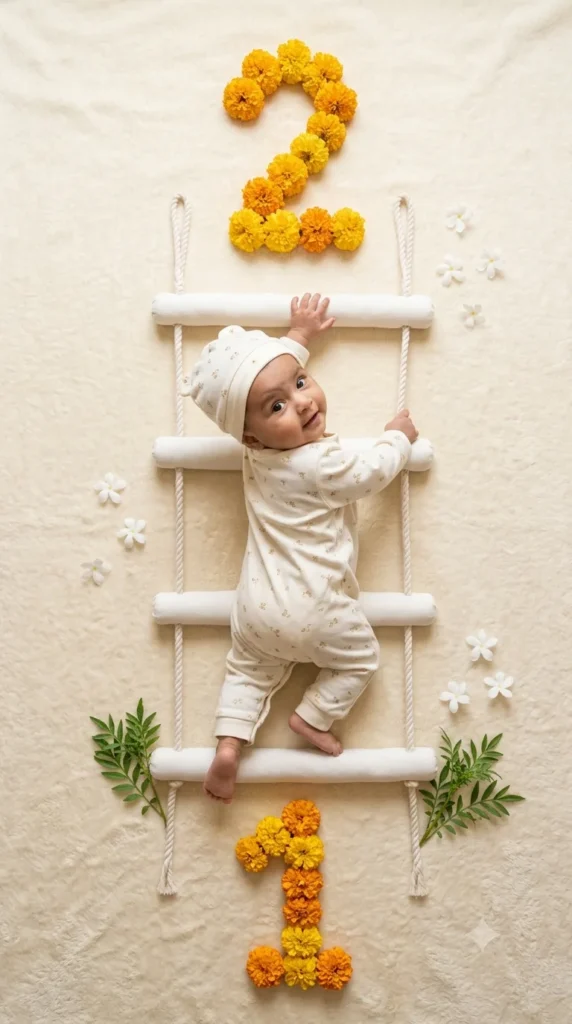
One Month Baby Photoshoot With Floral Number One Ladder
1. STRICT FACE IDENTITY COPY DNA
Use the uploaded reference image exclusively as the facial identity source for the baby. Directly copy the exact facial identity of the baby from the uploaded image into the generated image, including the exact head shape, forehead, hairline, eyebrows, eyelids, eye shape and spacing, iris appearance, nose, lips, cheeks, chin, ears, natural skin tone, skin texture, facial proportions, apparent age, and recognizable facial characteristics. Do not create a similar face, a face inspired by the reference, or a generic baby face. Do not beautify, reshape, enlarge the eyes, modify the nose, change the age, or stylize the facial features. The uploaded image is used only for exact facial identity copying; everything else must be reconstructed from the reference image.
2. VISUAL RECONSTRUCTION DNA
Reconstruct the reference as a creative baby milestone flat-lay photoshoot in which the baby is positioned on a small handcrafted white rope ladder laid vertically on a warm cream textured surface. The central visual concept is the ladder acting as the baby’s milestone prop, with a large number “2” made from yellow-orange marigold flowers placed above the ladder and a large number “1” made from yellow-orange marigold flowers placed below it. The baby is dressed in a soft cream printed baby outfit and lies naturally across the ladder while holding the rope sides. The entire scene is photographed from directly overhead.
3. SUBJECT & COMPOSITION DNA
Place the baby centrally within the vertical frame, occupying the middle portion of the composition. Position the white rope ladder vertically from near the upper-middle to the lower-middle of the frame. The floral “2” sits clearly above the ladder, while the floral “1” sits directly below the bottom of the ladder. Preserve the large vertical visual progression of 2 → baby on ladder → 1. Keep generous cream-colored negative space around the arrangement. Place small white flowers and green leafy sprigs sparsely around the ladder, matching the reference’s minimal decorative balance.
4. POSE & BODY LANGUAGE DNA
Reproduce the baby’s natural climbing-like pose on the ladder. The baby lies belly-down across the ladder, with the head turned back toward the camera and the face clearly visible. One arm reaches upward and grips the right-side rope, while the other arm extends toward the opposite side of the ladder. The legs extend downward along the ladder, with one leg slightly bent and the other extending toward the lower rung. Preserve the relaxed infant posture, natural limb proportions, tiny bare feet, and playful impression of the baby climbing upward.
5. OUTFIT & STYLING DNA
Dress the baby in the same soft cream/off-white full-length baby romper visible in the reference, featuring delicate tiny golden-beige printed motifs distributed across the fabric. Reproduce the matching soft cream baby cap with subtle small decorative details. The outfit should appear comfortable, slightly loose, and naturally wrinkled from the baby’s movement. Keep the baby’s feet uncovered. Do not add jewelry, shoes, additional accessories, or a different costume.
6. LADDER CONSTRUCTION DNA
Reconstruct the small vertical baby ladder from thick, soft-looking white cylindrical padded rungs connected by two long natural white ropes running vertically along both sides. Preserve the ladder’s handmade appearance, with several evenly spaced horizontal rungs extending between the side ropes. The ladder should lie flat against the cream surface while maintaining enough three-dimensional texture to clearly distinguish each rung and rope. Keep the ladder narrow enough to frame the baby naturally rather than becoming a large playground ladder.
7. FLORAL NUMBER “2” DNA
At the upper end of the composition, reproduce the large number “2” formed entirely from densely arranged yellow-orange marigold flowers. The numeral must be physically constructed from individual marigold flower heads, creating a rounded, organic floral silhouette. Preserve the exact simple shape and scale visible in the reference. Do not render the number as typed text, painted graphics, fabric, plastic, or a digital overlay. Individual marigold heads should remain visible so the viewer can clearly understand that the numeral is handcrafted from real flowers.
8. FLORAL NUMBER “1” DNA
Below the ladder, reproduce the large number “1” formed entirely from yellow-orange marigold flowers. Construct the numeral vertically from tightly arranged real marigold blossoms, including the angled top portion and straight vertical stem visible in the reference. Maintain the same approximate size and placement beneath the ladder. The number must look physically assembled on the surface from individual flowers rather than digitally typed or illustrated.
9. DECORATION & MATERIAL DNA
Add the small white five-petaled flowers visible around the ladder, including sparse individual blossoms near the upper-right, left-middle, and right-lower areas. Add small fresh green leafy sprigs beside the lower ladder and around the floral number “1.” Keep these decorative elements subtle and naturally spaced. All flowers and leaves must appear physically placed on the surface, with realistic petals, stems, leaves, shadows, and slight natural imperfections.
10. ENVIRONMENT / BACKGROUND DNA
Use a warm cream/off-white plush textured surface covering the entire background. Preserve the soft, slightly fuzzy textile texture and subtle tonal variation visible in the reference. The background should remain clean and minimal, allowing the white ladder, cream baby outfit, and bright marigold numbers to stand out. Do not introduce walls, furniture, baskets, toys, outdoor scenery, or additional props.
11. CAMERA DNA
Use a perfectly 90-degree overhead flat-lay camera angle, looking directly down at the entire arrangement. The ladder must appear vertically aligned within the frame, and the baby, floral numbers, flowers, and leaves should maintain the same flat-lay geometry as the reference. Keep the composition centered and undistorted without perspective tilt.
12. LENS & CAMERA DISTANCE DNA
Simulate a professional full-frame camera using approximately a 50mm lens positioned directly overhead at sufficient height to capture the complete ladder, both floral numbers, baby, and surrounding negative space. Avoid wide-angle distortion. Use approximately f/5.6–f/8 so the baby, ladder, flowers, grains or petals, and textured background remain clearly detailed throughout the frame.
13. LIGHTING DNA
Use soft, broad, evenly diffused overhead lighting. Illuminate the baby, ladder, marigold flowers, leaves, and cream surface uniformly. Preserve subtle natural shadows underneath the ladder rungs, ropes, flowers, and baby so the physical depth of every element remains visible. Avoid harsh shadows, dramatic highlights, colored lighting, or artificial glow.
14. COLOR GRADING & MOOD DNA
Preserve the reference palette of warm cream, soft white, yellow-orange marigold, natural green, and gentle baby skin tones. Maintain a bright, warm, peaceful, innocent, and playful milestone-photography mood. Keep the marigolds as the strongest color accent against the neutral background. Avoid excessive saturation, cinematic color grading, HDR effects, or unnatural color shifts.
15. IMAGE QUALITY DNA
Create an ultra-realistic 4K Ultra HD professional baby flat-lay photograph with authentic infant skin texture, fine natural hair, realistic cream fabric, individually distinguishable marigold flower heads, natural flower petals, detailed leaves, soft rope fibers, padded ladder rungs, and subtle textile texture. Every object must look physically present and photographed rather than digitally illustrated or composited.
16. NEGATIVE / EXCLUSION DNA
Do not change the copied facial identity. Do not create a generic baby face. Do not replace the ladder with a swing, staircase, wooden ladder, basket, or other prop. Do not replace the marigold numbers with digital typography, painted numbers, balloons, paper, beads, or unrelated materials. Do not change the numbers: the upper number must be “2” and the lower number must be “1.” Do not add “MONTH,” “TWO MONTHS,” “ONE MONTH,” or any other text because no such wording is visible in the reference. Avoid extra toys, furniture, excessive flowers, additional people, distorted anatomy, unnatural baby proportions, malformed hands or feet, wide-angle distortion, artificial flowers, and creative redesign of the reference.
17. OUTPUT DNA
Generate one ultra-realistic 4K Ultra HD image in a strict vertical 9:16 aspect ratio, faithfully reconstructing the supplied reference as a baby milestone flat-lay photoshoot. Preserve the directly copied baby facial identity, cream printed romper and cap, natural climbing pose on the white rope ladder, vertically positioned padded ladder, large marigold-flower “2” above the ladder, large marigold-flower “1” below the ladder, sparse white flowers, green leafy sprigs, and warm cream textured background. The reference image remains the primary source of truth for composition, proportions, materials, placement, camera geometry, lighting, and overall visual appearance.
How to Create These Images
To recreate these concepts with an AI image generator such as Gemini, start by clearly describing the baby’s age, position, clothing, background, lighting, camera perspective, and milestone number. Describe handcrafted decorations specifically rather than simply asking for a “creative setup.” For example, if the reference uses lentils or grains, explain that the shapes and numbers are physically arranged from those individual materials. This helps preserve the handmade appearance of the concept.
For newborn photography, keep the baby’s pose natural and comfortable, with soft fabrics and gentle lighting. Props should remain decorative and positioned safely away from the baby’s face, mouth, and hands. A vertical 9:16 composition works especially well for mobile-friendly baby milestone images, social media posts, and visual prompt collections.
Which Platform Is Better for Creating One Month Baby Photos?
Gemini AI can be useful when you want to experiment with detailed baby milestone concepts from a written prompt or reference idea. The most important part is giving the model precise instructions about composition, materials, lighting, clothing, and the placement of the milestone number. For actual newborn photography, however, a professional camera setup gives greater control over natural skin texture, expressions, lighting, and safe posing.
Bottom Line
A one month baby photoshoot does not need an elaborate studio setup to become memorable. Simple elements such as flowers, grains, pulses, greenery, soft blankets, and a carefully designed number one can transform an ordinary milestone photograph into something distinctive. Whether you prefer a cute teddy-bear concept, a natural floral arrangement, or a playful ladder composition, the focus should remain on the baby’s comfort and authentic expression.