Create Image For 2 Month Baby photoshoot using prompt seen below
- STRICT FACE IDENTITY COPY DNA
Use the uploaded reference image exclusively as the facial identity source for the baby. Directly copy the exact facial identity from the uploaded image, including the exact head shape, forehead, natural hairline, eyebrow structure, eyelids, eye shape and spacing, nose, lips, cheeks, chin, ears, natural skin tone, skin texture, facial proportions, apparent age, and every recognizable facial characteristic. Do not create a similar baby or generic baby face. Do not beautify, reshape, stylize, age, de-age, or modify the facial features. The uploaded image is used only for facial identity; every other element must be reconstructed from this current reference.
- VISUAL RECONSTRUCTION DNA
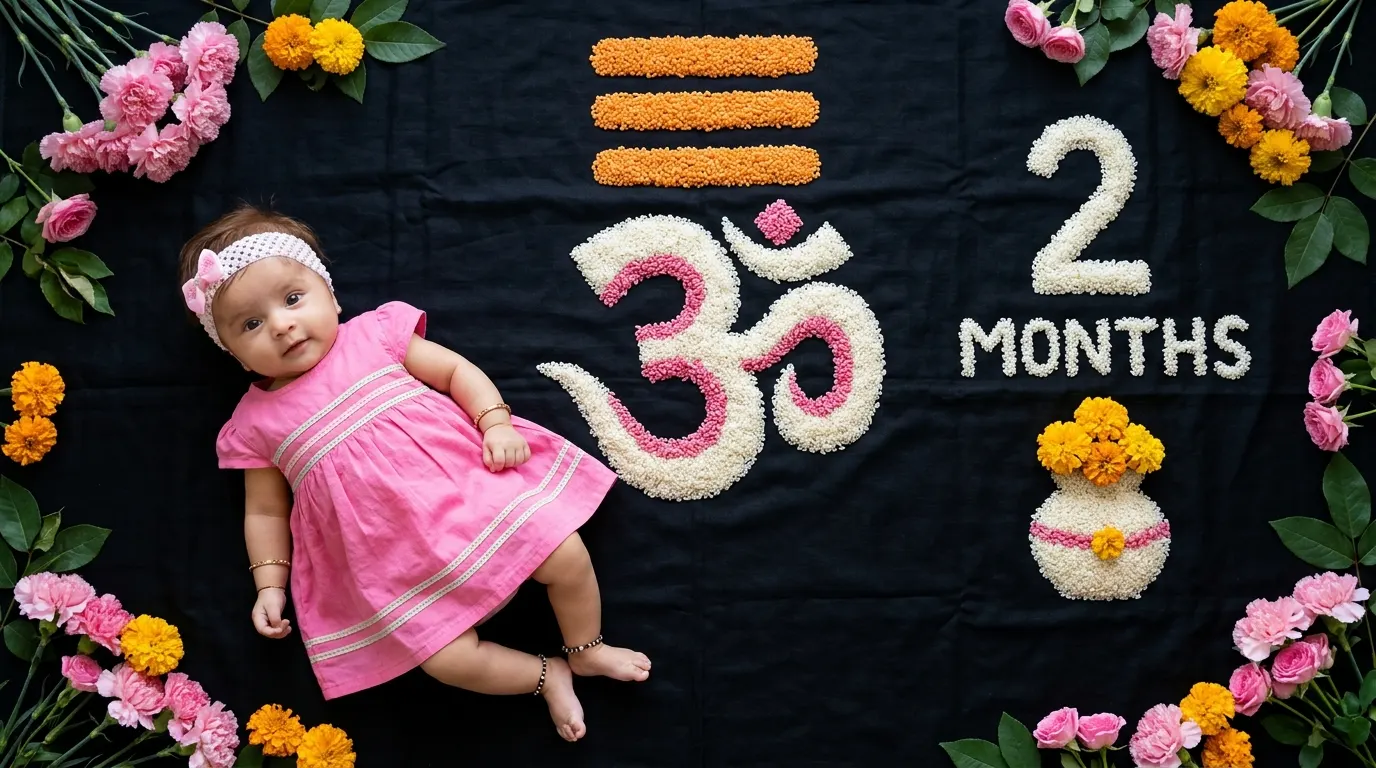
Reconstruct the reference as a carefully arranged overhead baby milestone photoshoot on a deep black fabric background. The main visual concept is a baby positioned in the lower-left area surrounded by handcrafted artwork made from tiny grains and flowers. The composition contains a large central decorative symbolic shape, a large grain-crafted “2 MONTHS” milestone message in the upper-right, a small decorative vessel/kalash-like shape made from grains and flowers on the right-center, and floral/leaf decorations around the outer edges.
Treat the reference as a physical flat-lay reconstruction. Every decorative shape must look manually arranged on the black fabric rather than digitally illustrated.
- SUBJECT & COMPOSITION DNA
Place the baby in the lower-left quadrant, lying diagonally across the black fabric. The baby's head is toward the left-middle area while the body and legs extend diagonally toward the lower-right. Keep substantial black negative space around the baby.
The large handcrafted symbolic artwork occupies the upper-middle portion. The “2 MONTHS” milestone occupies the upper-right quadrant. The small floral/grain decorative object sits below the milestone text toward the center-right. Preserve the generous spacing between these elements.
Maintain the decorative pink flowers and green leaves around the outer edges and corners exactly as visible.
- POSE & BODY LANGUAGE DNA
Reconstruct the baby's pose exactly as shown. The baby lies on the back at a diagonal angle with the head toward the left, one arm raised upward with a naturally closed infant fist, and the other arm resting downward beside the body. The legs are naturally bent and separated, with one leg extending toward the lower-right and the other angled downward.
Preserve the exact body orientation, limb positioning, hand positions, leg angles, and natural infant proportions. Do not turn the baby into a sitting, standing, centered, or sleeping pose.
- OUTFIT & STYLING DNA
Recreate the bright pink baby dress visible in the reference. The dress has short sleeves with small shoulder bow-like extensions, a fitted upper section, and a wide flared skirt. Preserve the lighter pink decorative patterning across the fabric and the distinct pale/white horizontal decorative trim running across the lower portion of the skirt.
The dress should have realistic soft fabric folds and natural volume. Do not replace it with another dress style.
- BABY ACCESSORIES DNA
Preserve the white textured headband positioned around the baby's head. Reconstruct the small bracelets/bangles visible on the baby's wrists and the delicate dark anklets around the legs.
Keep the accessories small and realistically scaled to the baby. Do not add additional jewelry or accessories.
- CENTRAL GRAIN-CRAFTED SYMBOL DNA
The large central artwork is a major visual element. Reconstruct its exact abstract devotional-looking symmetrical shape using densely arranged tiny white and pink grains.
The shape has a broad upper section with two outward-curving pointed forms, two small circular white grain details inside the upper side shapes, a narrow central vertical structure, and a large curved lower extension resembling a stylized trunk-like form. The interior central vertical area is predominantly pink grains, while the surrounding structure is predominantly white grains.
Above this artwork are three separate horizontal orange grain bars, stacked vertically with decreasing/increasing widths as shown. Preserve their exact number, spacing, thickness, and orange color.
Do not reinterpret, redesign, simplify, or replace this symbol with a different religious icon. Reconstruct only the visible geometry from the reference.
- GRAIN MATERIAL DNA
All major artwork must visibly consist of tiny individual grains arranged closely together. White grains form the main artwork, pink grains form the central interior section, and orange grains form the three horizontal bars and selected decorative areas.
The grains should have natural irregularity, tiny gaps, overlapping edges, and subtle physical shadows. The artwork must look handmade and physically placed on the black fabric.
Do not use smooth vector graphics, painted shapes, digital typography, plastic beads, or perfectly uniform computer-generated lines.
- TEXT & TYPOGRAPHY DNA
Text is a core visual element and must be reconstructed exactly.
The visible text in the upper-right reads:
2
MONTHS
The numeral “2” is large and positioned above the word. Both the numeral and the word “MONTHS” are constructed from densely arranged small white grains.
Preserve the exact wording, capitalization, spelling, line arrangement, approximate proportions, spacing, and handcrafted grain texture. Do not change “MONTHS” to “Months,” “MONTH,” “MONTH'S,” or any other wording.
The lettering should look physically constructed from individual grains rather than digitally typed.
- FLORAL VESSEL / DECORATIVE OBJECT DNA
Below the milestone text and toward the center-right is a small rounded decorative object formed primarily from white grains. Its lower body is a rounded white grain-filled shape, with a cluster of orange flowers emerging from its upper portion. A small orange floral detail is positioned on its front center.
Reconstruct its exact visible silhouette, scale, floral arrangement, and position. Do not replace it with an unrelated object.
- FLORAL BORDER DNA
Preserve the small pink flower clusters arranged intermittently around the outer edges of the black background. These include vertical clusters along the left and right sides and additional flowers near the corners.
Also preserve the green leaves visible at the upper corners and lower corners, along with the small yellow/orange floral accents where visible.
These elements should remain physical flowers and leaves placed directly on the fabric.
- ENVIRONMENT / BACKGROUND DNA
Use a deep matte black fabric sheet covering the entire scene. Preserve subtle wrinkles, folds, and natural fabric texture.
The black fabric must remain visible through the negative spaces between all decorative elements. Do not replace it with a smooth black digital background or another surface.
- CAMERA DNA
Use a perfectly 90-degree overhead camera angle, directly above the complete arrangement. This is a true flat-lay photograph with no tilted perspective.
The camera must capture the baby, central artwork, milestone typography, floral object, and edge decorations as one unified physical arrangement.
- LENS & CAMERA DISTANCE DNA
Use a professional full-frame camera with an approximately 50mm low-distortion lens positioned high enough to capture the entire horizontal arrangement. Preserve natural baby proportions and the exact spatial relationships between all objects.
- LIGHTING DNA
Use soft, evenly diffused overhead lighting. The baby should have natural skin highlights with soft shadows. The tiny grains should produce subtle micro-shadows against the black fabric, making their physical arrangement clearly visible.
Keep the flowers naturally illuminated and preserve the dimensional texture of the fabric without dramatic directional shadows.
- COLOR GRADING & MOOD DNA
Preserve the reference's dominant palette of deep black, white, bright pink, orange/yellow, and natural green, with the baby's pink dress providing the main color accent.
The mood should feel joyful, delicate, celebratory, handcrafted, and suitable for a baby milestone photoshoot. Keep skin tones natural and avoid excessive saturation.
- VISUAL DEPTH & MATERIAL DNA
Make the entire arrangement physically believable. Individual grains should have visible texture and tiny shadows. Flowers should have individual petals and natural volume. Leaves should show realistic veins and slight curling. The black fabric should retain its wrinkles.
The baby must look like a real infant photographed on top of the same physical setup, not composited into a digital illustration.
- TEXT RECONSTRUCTION DNA
Do not guess or reinterpret any text. The only visible written milestone text is:
2
MONTHS
Reproduce these exact characters in the same two-line arrangement using white grains. Preserve the handcrafted irregularity of the grain letters while keeping the wording completely readable.
- IMAGE QUALITY DNA
Create an ultra-realistic 4K Ultra HD professional baby flat-lay photograph with realistic infant skin, fine hair, authentic fabric texture, detailed dress embroidery/patterning, individual rice/grain particles, natural flower petals, realistic leaves, and physically accurate shadows.
The final result must look like a real photograph of a manually constructed grain-and-flower photoshoot.
- NEGATIVE / EXCLUSION DNA
Do not change the copied facial identity. Do not change the baby's pose, position, dress, accessories, or body orientation. Do not redesign the central artwork or assign it a different symbolic meaning. Do not replace grain artwork with paint, beads, cotton, petals, or digital graphics. Do not change “2 MONTHS” to any other wording or capitalization. Do not add names, dates, captions, logos, or unrelated objects. Do not add extra religious symbols that are not visible. Remove any social-media username, watermark, interface icon, or platform overlay visible in the reference; these are not part of the photoshoot. Avoid smooth vector shapes, perfectly typed-looking grain letters, malformed text, artificial CGI grains, distorted baby anatomy, extra fingers, extra limbs, duplicated flowers, or unrealistic materials.
- OUTPUT DNA
The uploaded reference is horizontal, therefore generate strictly in 16:9. Create one ultra-realistic 4K image faithfully reconstructing this exact current reference: the baby lying diagonally in the lower-left wearing the same pink dress and white headband, the large white-and-pink handcrafted grain artwork in the upper-middle with three orange grain bars above it, the exact “2 MONTHS” white grain typography in the upper-right, the small white-and-orange floral decorative object below it, and the pink flowers, yellow/orange flowers, and green leaves framing the black fabric.
The current reference is the sole visual source. Do not carry forward any theme, object, styling, composition, or concept from previous images.