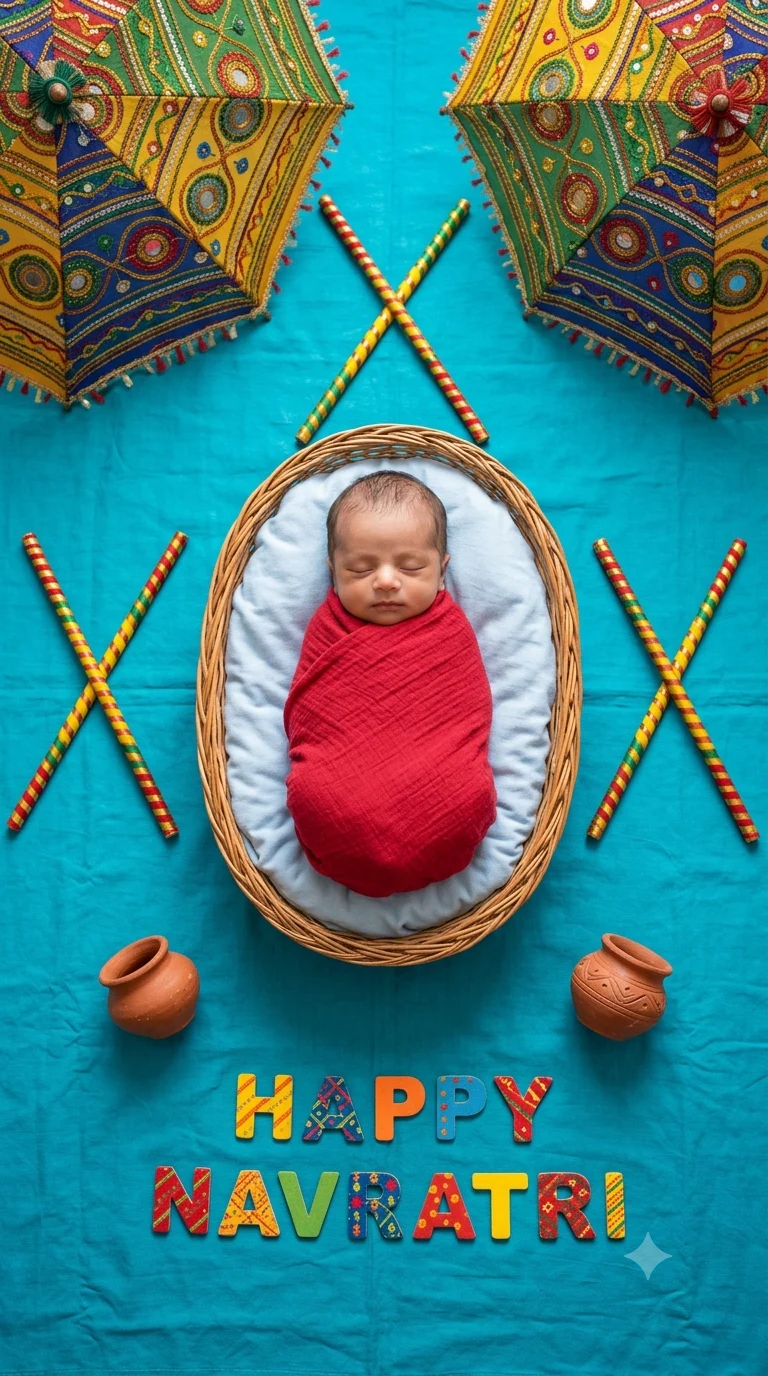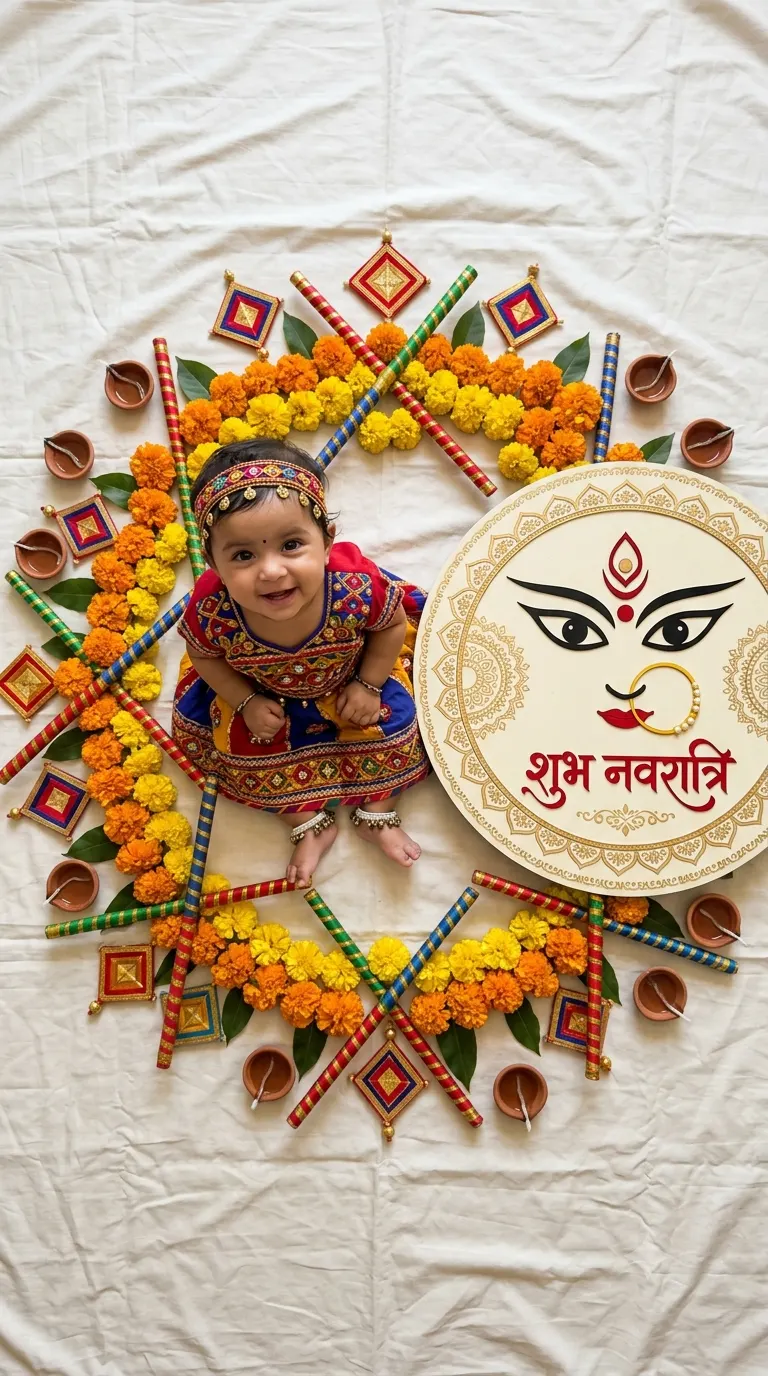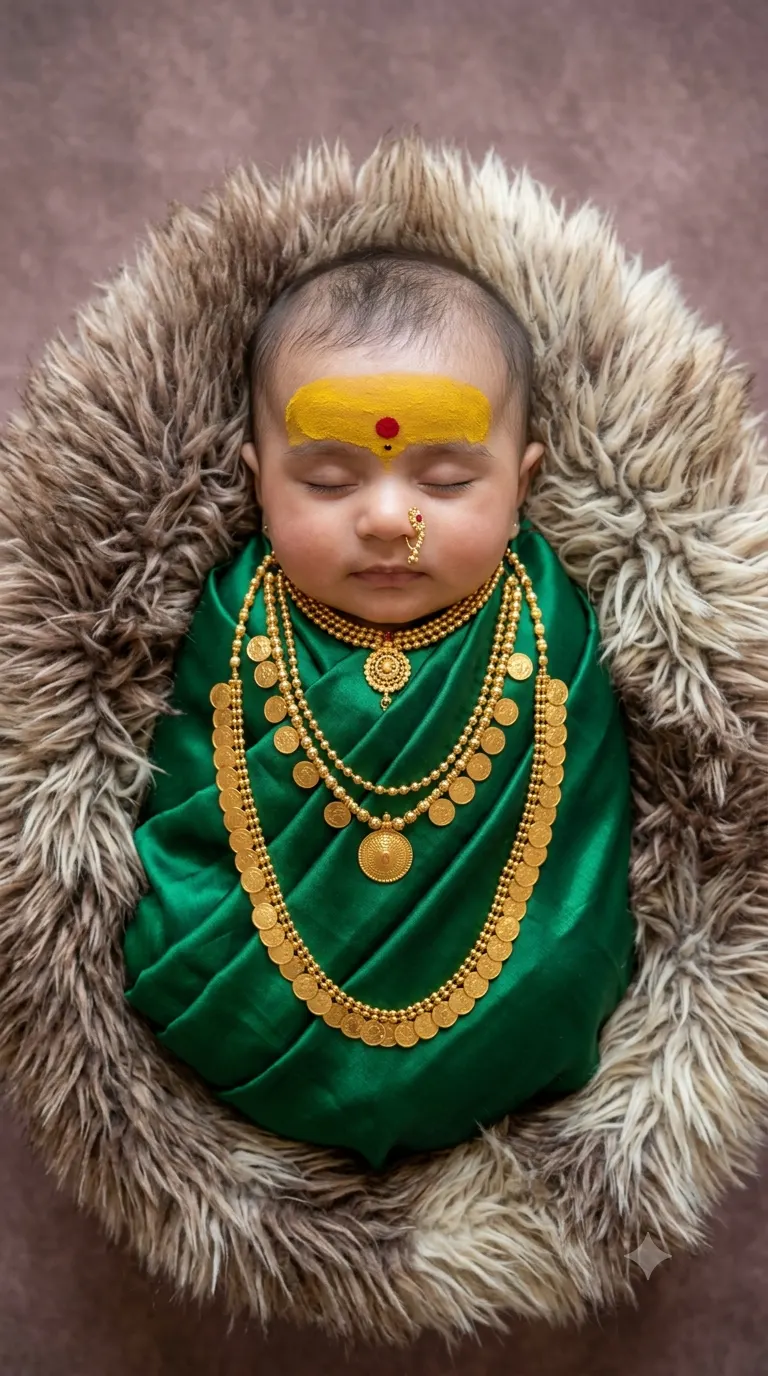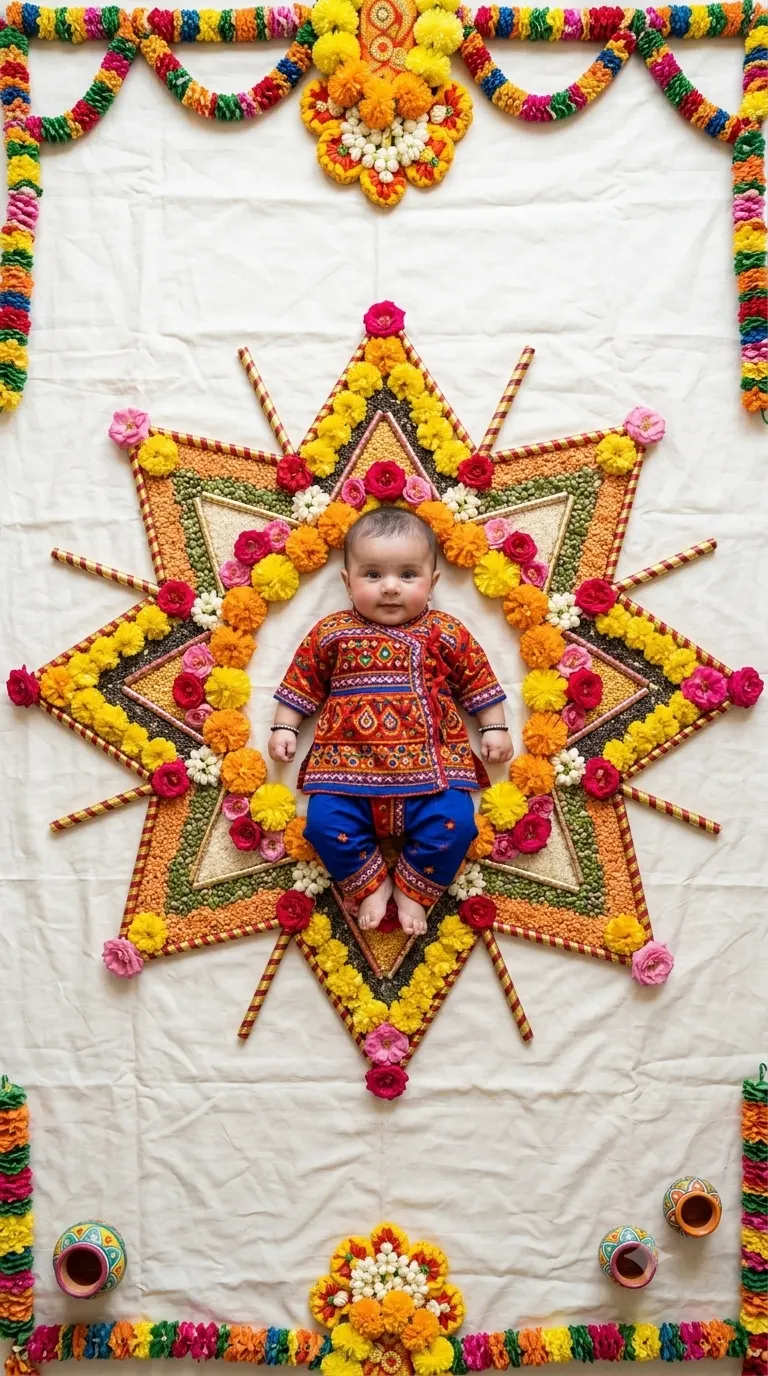
Navratri Baby Photoshoot Prompt seen Here is Like Rangoli!
Baby
Create Image Baby Photoshoot With Colorful Navratri-Inspired Geometric Floral Rangoli using prompt seen below 1. STRICT FACE IDENTITY …
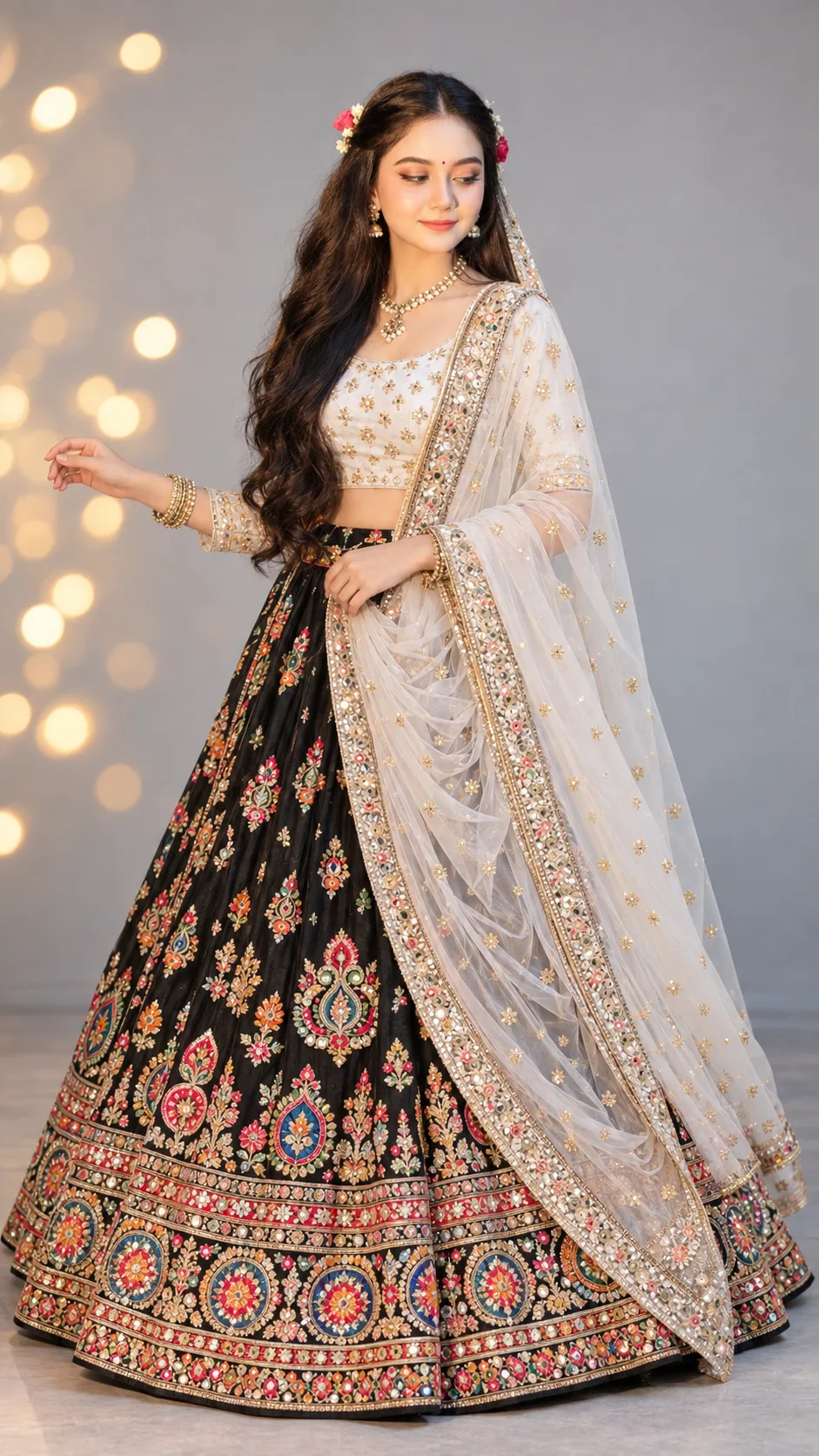
Create Image of Navratri girl look using prompt seen below.
Use the uploaded reference image exclusively as the facial identity source for the woman. Directly copy the exact facial identity of the woman from the uploaded image into the generated image, including her exact head shape, forehead proportions, natural hairline, eyebrow shape and density, eyelids, exact eye shape and spacing, iris appearance, nose bridge and tip, nostril structure, lips, cheeks, jawline, chin, ears, natural skin tone, skin texture, facial proportions, apparent age, and every recognizable facial characteristic. Do not create a similar face, a face inspired by the reference, or a generic model face. Do not beautify, reshape, slim, age, de-age, enlarge the eyes, modify the nose, sharpen the jaw, or otherwise alter her facial features. Use the uploaded image only for exact facial identity copying; reconstruct everything else from the visual blueprint below.
Reconstruct the reference as a full-length traditional Indian fashion portrait of the woman standing in a studio setting. Preserve the overall visual appearance: a richly embroidered black lehenga with multicolored traditional motifs, a white embellished blouse, a sheer white dupatta with a decorative border draped across the front, long wavy brown hair, traditional jewelry, and an elegant relaxed standing pose. The image has a clean pale gray studio background with soft circular bokeh lights toward the left side and a minimal fashion-catalogue aesthetic.
Place the woman centrally in the vertical frame, occupying most of the image from head to near the bottom of the lehenga. Preserve the full-body framing, including the complete flared skirt and the visible floor area beneath it. Her body faces generally toward the camera while her head is turned slightly downward and toward her left. Keep the subject positioned slightly above center with sufficient breathing room above her head and around the skirt.
Reproduce the elegant standing pose from the reference. Her left arm extends outward toward the left side with the hand gently raised and fingers naturally relaxed, while her right arm bends across the waist and lightly holds the dupatta. Her shoulders remain relaxed, torso upright, and weight naturally distributed through the legs beneath the lehenga. Her head tilts slightly downward, with her gaze directed toward the lowered side rather than directly into the camera. Preserve the graceful, modest fashion-pose body language.
Reconstruct the outfit as a richly decorated traditional Indian black lehenga choli. The blouse is predominantly white with small gold decorative motifs, a fitted cropped silhouette, a modest neckline, and three-quarter sleeves covered with delicate embellishment. The lehenga skirt is deep black and heavily decorated with repeated colorful traditional embroidered motifs in red, orange, green, blue, pink, gold, and cream. The skirt has a very wide flowing flare and an elaborate multi-row embroidered hem containing geometric and circular traditional patterns. Preserve the dense handcrafted textile appearance and the exact visual richness of the reference.
Reproduce the lightweight sheer white dupatta with a broad ornate gold-and-white embellished border. It is draped over the woman's head and shoulders and falls across the front of her body in multiple soft layered folds. Preserve its translucent quality, delicate small gold motifs, decorative edging, natural fabric wrinkles, and graceful curved draping. The dupatta must remain visually prominent across the front of the outfit.
Reconstruct the woman's long, voluminous wavy brown hair flowing over her shoulders and down the left side of her body. Preserve the soft natural waves and side-parted styling. Add the visible traditional jewelry: a delicate pearl-style necklace, matching dangling earrings, slim bangles on both wrists, and subtle traditional accessories. Keep the jewelry elegant and proportionate rather than excessive.
Use a clean light gray studio background with a subtle smooth tonal gradient. Preserve the soft out-of-focus circular warm-white bokeh lights appearing primarily along the left side of the frame at different heights. Keep the studio environment minimal and uncluttered. Do not introduce a temple, outdoor setting, festival crowd, furniture, architecture, or decorative backdrop.
Use a professional fashion-portrait camera positioned approximately at the woman's torso-to-eye level with a mostly frontal perspective. Capture the complete subject from head to the bottom of the lehenga, including the full flare of the skirt and a small amount of floor space. Preserve the reference's straight vertical fashion-catalogue composition and natural body proportions.
Simulate a professional full-frame camera using approximately an 85mm portrait lens positioned roughly 3–4 metres from the woman. Use approximately f/4–f/5.6 to keep the woman, intricate outfit, jewelry, and dupatta sharply detailed while producing a softly blurred studio background and bokeh. Avoid wide-angle distortion and preserve realistic body proportions.
Use soft professional studio lighting from the front and slightly to the side, producing even illumination across the face and clothing. Add subtle highlights to the white dupatta, jewelry, embroidered motifs, and glossy fabric details while retaining realistic shadows in the folds of the black lehenga. Preserve the gentle warm-white bokeh lights in the background. Avoid harsh flash, dramatic colored lighting, or excessive glow.
Preserve the sophisticated palette of black, white, gold, and vivid multicolored embroidery, complemented by the pale gray background and warm-white bokeh. The mood should feel elegant, festive, refined, traditional, and premium, like a professional Indian fashion catalogue portrait. Keep skin tones natural and textile colors rich without excessive saturation.
Create an ultra-realistic 4K Ultra HD professional fashion photograph with authentic skin texture, individual hair strands, realistic jewelry reflections, detailed embroidery threads, woven textile texture, translucent dupatta fabric, natural fabric folds, and physically believable studio lighting. The image should look like a professionally photographed Indian fashion portrait rather than an AI illustration or CGI render.
Do not change the copied facial identity. Do not create a generic model face. Do not redesign the lehenga, blouse, dupatta, hairstyle, jewelry, pose, camera framing, background, bokeh placement, or overall composition. Do not replace the black embroidered lehenga with another color or style. Do not remove the sheer white dupatta or its ornate border. Do not simplify the embroidery. Avoid extra people, furniture, temple backgrounds, festival decorations, excessive beauty retouching, plastic skin, distorted hands, extra fingers, malformed jewelry, unrealistic fabric, excessive makeup, wide-angle distortion, or creative reinterpretation.
Generate one ultra-realistic 4K Ultra HD image in a strict vertical 9:16 aspect ratio, faithfully reconstructing the supplied reference. Preserve the directly copied facial identity, full-length standing pose, black multicolored embroidered lehenga, white embellished blouse, sheer white bordered dupatta, long wavy hair, traditional jewelry, pale gray studio background, left-side warm bokeh, full skirt framing, and overall premium Indian fashion-photography aesthetic. The reference image is the primary source of truth for the complete visual reconstruction; do not redesign or creatively reinterpret any element unless explicitly requested.
Explore more prompts related to this one.