
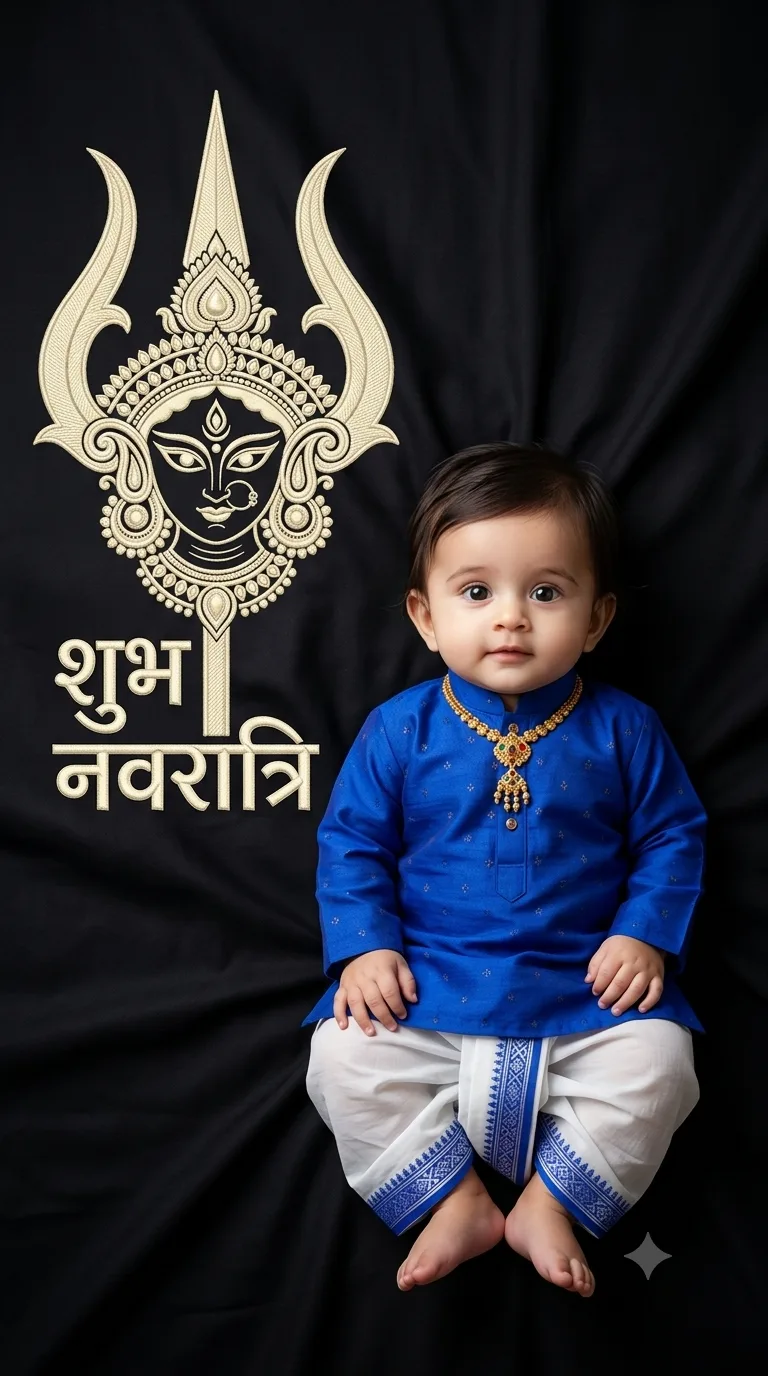
Navratri Baby Photoshoot Prompts
Prompt
Create Image — Navratri Baby Photoshoot
- STRICT FACE IDENTITY COPY DNA
Use the uploaded reference image to directly copy the exact facial identity of the baby boy into the generated image. Reproduce his recognizable head shape, forehead, hairline, eyebrows, eye shape and spacing, nose, lips, cheeks, chin, ears, natural skin tone, skin texture, and apparent age as closely as the image-generation model allows. Do not substitute a generic baby face, beautify, reshape, or stylize his facial features. The same recognizable baby identity must be maintained while reconstructing the scene, clothing, pose, decorative artwork, background, and photographic arrangement described in the following sections. - VISUAL RECONSTRUCTION DNA
Reconstruct the reference as a Navratri baby photoshoot featuring a baby boy beside an ornamental representation of Maa Durga created using a Trishul-inspired design, with the Hindi greeting “शुभ नवरात्रि” beneath it. Preserve the original concept: a seated baby on the right, a large cream-gold devotional design on the left, and a deep black fabric background. The distinctive feature is that the trident is not merely a standalone symbol; its central shaft, prongs, curved contours, and ornamental facial-like details combine to suggest the form of Maa Durga. Retain this visual relationship, the original decorative style, the negative space, and the restrained palette. Do not replace the artwork with a conventional Durga illustration or a different religious symbol. - SUBJECT & COMPOSITION DNA
Place the baby boy on the right side of the composition, occupying approximately the right third of the main artwork. Position the large Trishul-inspired Maa Durga design on the left, with the two-line Hindi greeting directly underneath. Keep the baby, devotional artwork, and lettering visually distinct but balanced as one composition. Preserve the substantial black negative space surrounding these elements. Maintain the original relative scale of the baby and decorative artwork, avoiding unnecessary enlargement or repositioning. Adapt the arrangement to a strict vertical 9:16 canvas, ensuring that the complete devotional design, both text lines, and the baby's entire visible figure fit within the frame. - POSE & BODY LANGUAGE DNA
Reproduce the baby's upright seated pose, facing forward with a gentle, natural expression and his gaze directed toward the camera. Keep his head straight, shoulders relaxed, and torso upright. One arm bends inward toward his abdomen, while the other rests naturally beside his body. His legs extend downward in a relaxed seated position, with the white traditional lower garment draped around them and his bare feet visible. Preserve the original limb positioning, body proportions, and natural silhouette. Do not change the pose to standing, crawling, reclining, or cross-legged sitting. - OUTFIT & STYLING DNA
Dress the baby in a vivid royal-blue traditional Indian kurta with long sleeves, a simple neckline, a short front opening, and small, subtle decorative details. The fabric should appear soft, with realistic folds and a rich blue color. Pair it with a white dhoti-style lower garment featuring narrow royal-blue patterned borders along the visible edges. Reproduce the loose draping, layered folds, and traditional styling visible in the reference. Keep the baby's feet bare. Do not introduce a crown, turban, elaborate jewelry, footwear, or additional accessories that are absent from the reference. - ENVIRONMENT / BACKGROUND DNA
Recreate the deep-black fabric backdrop with subtle natural folds, shallow creases, and understated variations in the textile. The background should resemble real black studio drapery rather than a flat digital fill, gradient, painted wall, or temple interior. Preserve the dark, uncluttered environment so the royal-blue outfit and cream-gold devotional artwork stand out clearly. Do not add flowers, garlands, furniture, temple architecture, decorative borders, lamps, or additional religious objects. - TEXT & TYPOGRAPHY DNA
Reproduce the exact Hindi greeting “शुभ नवरात्रि”, as specified for this reference. Arrange it in two lines, with “शुभ” on the upper line and “नवरात्रि” beneath it. Preserve the correct Devanagari characters, matras, connected strokes, word spacing, and spelling. Match the reference's pale cream-gold color and intricate dotted, beaded, or embroidered appearance. Reconstruct the ornamental letterforms rather than using plain typed text. Maintain the original relative size of each line, the horizontal alignment, the spacing between lines, and the position directly beneath the Trishul-inspired Maa Durga design. Do not translate the greeting, change the wording, introduce English text, or add unrelated captions. The lettering must remain clearly readable and visually integrated with the devotional artwork. - ORNAMENTAL SYMBOL & MAA DURGA DESIGN DNA
Reconstruct the large upright Trishul-inspired ornamental design positioned on the left. Its upper section features three pointed prongs, with a taller central point and gracefully curved outer prongs. The central shaft extends downward into a symmetrical arrangement of decorative curves, extensions, and facial-like ornamental details that collectively suggest Maa Durga's face. Preserve this distinctive interpretation of the goddess using the Trishul structure rather than depicting a separate full-body goddess, a conventional portrait, or an unrelated religious icon. Render the design in pale ivory-gold with fine dotted, beaded, or embroidered detailing. Match the original linework, symmetry, proportions, decorative extensions, and placement above the Hindi greeting. Keep the symbol flat and finely detailed against the black fabric, without adding metallic three-dimensional effects or changing its silhouette. - CAMERA DNA
Use a straight-on, front-facing camera angle, with the camera sensor parallel to the background. Maintain a neutral perspective without noticeable upward or downward tilt. Frame the baby and devotional artwork together so that the complete visible figure, entire Trishul-inspired design, both lines of Hindi lettering, and surrounding black fabric remain visible. Preserve the reference's asymmetrical composition, with the baby on the right and the devotional design on the left. Avoid diagonal framing, extreme perspective distortion, tight cropping, or camera placement that makes either the baby or lettering disproportionately dominant. - LENS & CAMERA DISTANCE DNA
Simulate a professional full-frame camera with a natural 50 mm lens perspective, positioned approximately 2.5–3.5 metres from the arrangement and adjusted to fit the complete composition. Keep the camera height neutral and the sensor parallel to the background. Use approximately f/5.6 depth of field so the baby's outfit, ornamental contours, Hindi lettering, and background fabric remain sufficiently clear. Avoid wide-angle distortion, excessive telephoto compression, shallow focus that blurs the greeting, and artificial background blur. - LIGHTING DNA
Use soft, diffused frontal studio lighting with gentle fill. Illuminate the baby's face and royal-blue clothing evenly while retaining natural skin texture and realistic fabric folds. Provide enough illumination to reveal the fine cream-gold detailing of the Trishul-inspired Maa Durga design and the Hindi lettering without washing out their texture. Keep the black fabric dark and dimensional, with subtle shadows revealing its folds. Avoid harsh flash, dramatic colored lights, excessive glow, blown highlights, and lighting that turns the black background gray. - COLOR GRADING & MOOD DNA
Preserve the reference's restrained palette of deep black, vivid royal blue, white, and pale ivory-gold. Maintain strong contrast between the baby, devotional artwork, and background. The overall mood should feel devotional, festive, traditional, and calm, appropriate for a Navratri baby photoshoot. Keep skin tones natural and fabric colors realistic. Avoid introducing additional dominant colors, dramatic cinematic effects, excessive saturation, or color grading that changes the reference's original visual character. - IMAGE QUALITY DNA
Create an ultra-realistic, high-detail studio photograph with natural baby skin texture, anatomically plausible hands and feet, realistic fabric folds, clean ornamental contours, and carefully rendered Devanagari lettering. Preserve the fine dotted or beaded texture of the cream-gold artwork and the subtle folds of the black textile. Ensure the Trishul-inspired design remains symmetrical and recognizable, while the Hindi greeting stays legible. Avoid plastic-looking skin, excessive smoothing, cartoon rendering, malformed fingers, distorted anatomy, inconsistent garment borders, blurred text, and artificial decorative textures. - NEGATIVE / EXCLUSION DNA
Do not alter the core composition, baby's seated pose, royal-blue kurta, white dhoti, bare feet, black fabric background, Trishul-inspired Maa Durga design, or Hindi greeting. Do not replace the goddess-inspired ornamental design with a conventional Durga illustration, a different religious symbol, or a generic trident icon. Do not change “शुभ नवरात्रि” to different wording or add captions, English text, or watermarks. Exclude extra babies, people, statues, flowers, garlands, furniture, temple architecture, decorative frames, lamps, and unrelated props. Avoid incorrect Devanagari characters, duplicated trident prongs, distorted facial-like ornamentation, artificial facial beautification, excessive effects, and unnecessary creative deviations. - OUTPUT DNA
Generate one ultra-realistic, 4K Ultra HD image in a strict vertical 9:16 aspect ratio. Reconstruct the reference as faithfully as possible, retaining the baby's placement and outfit, the black textile backdrop, the cream-gold Trishul-inspired Maa Durga design, and the exact two-line Hindi greeting “शुभ नवरात्रि”. Preserve the relative proportions, decorative details, negative space, lighting, and visual hierarchy. Ensure that all essential elements are fully visible, correctly positioned, and clearly legible. Do not add new visual elements or redesign the reference.