One Month Baby Girl Photoshoot Gemini Prompt
Baby
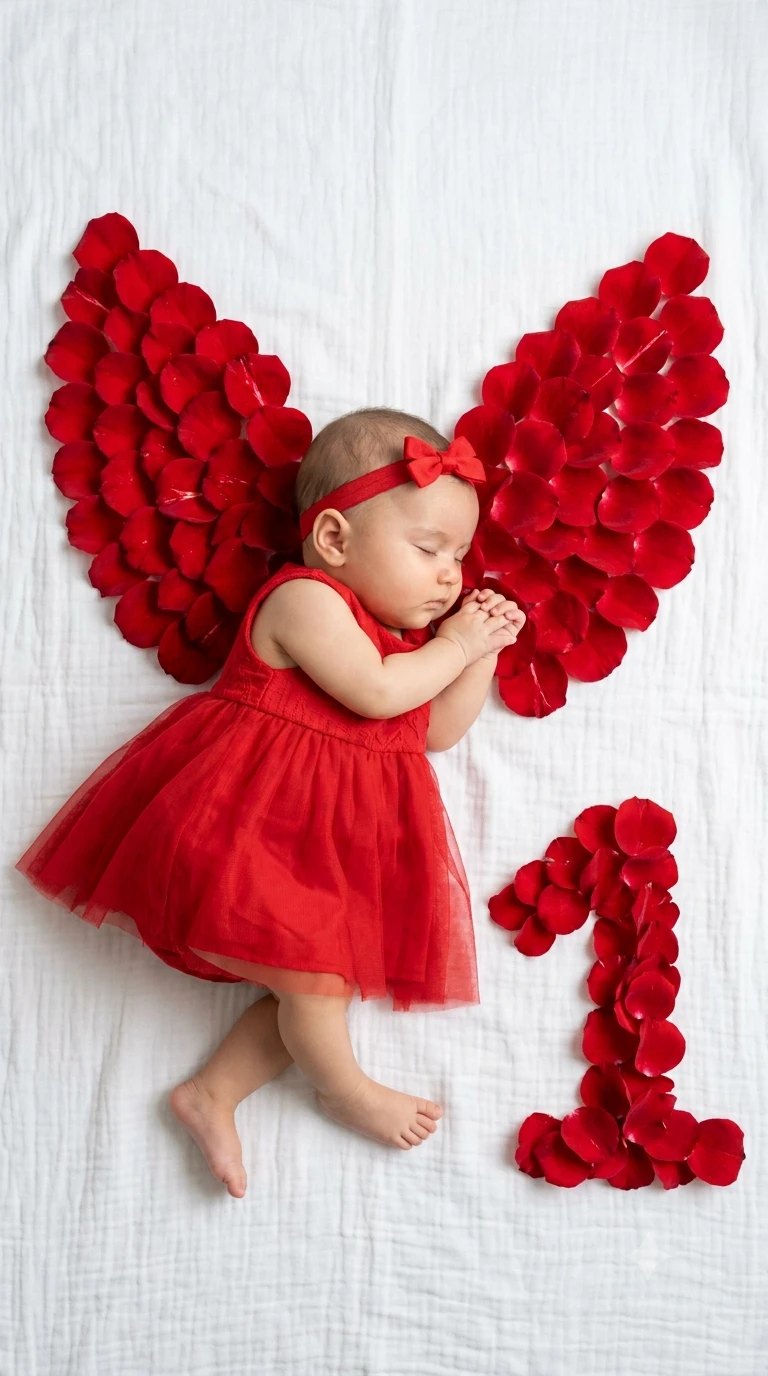
Create Image Baby Milestone Red Angel Wings With Floral Number 1 1. STRICT FACE IDENTITY COPY DNA Use …
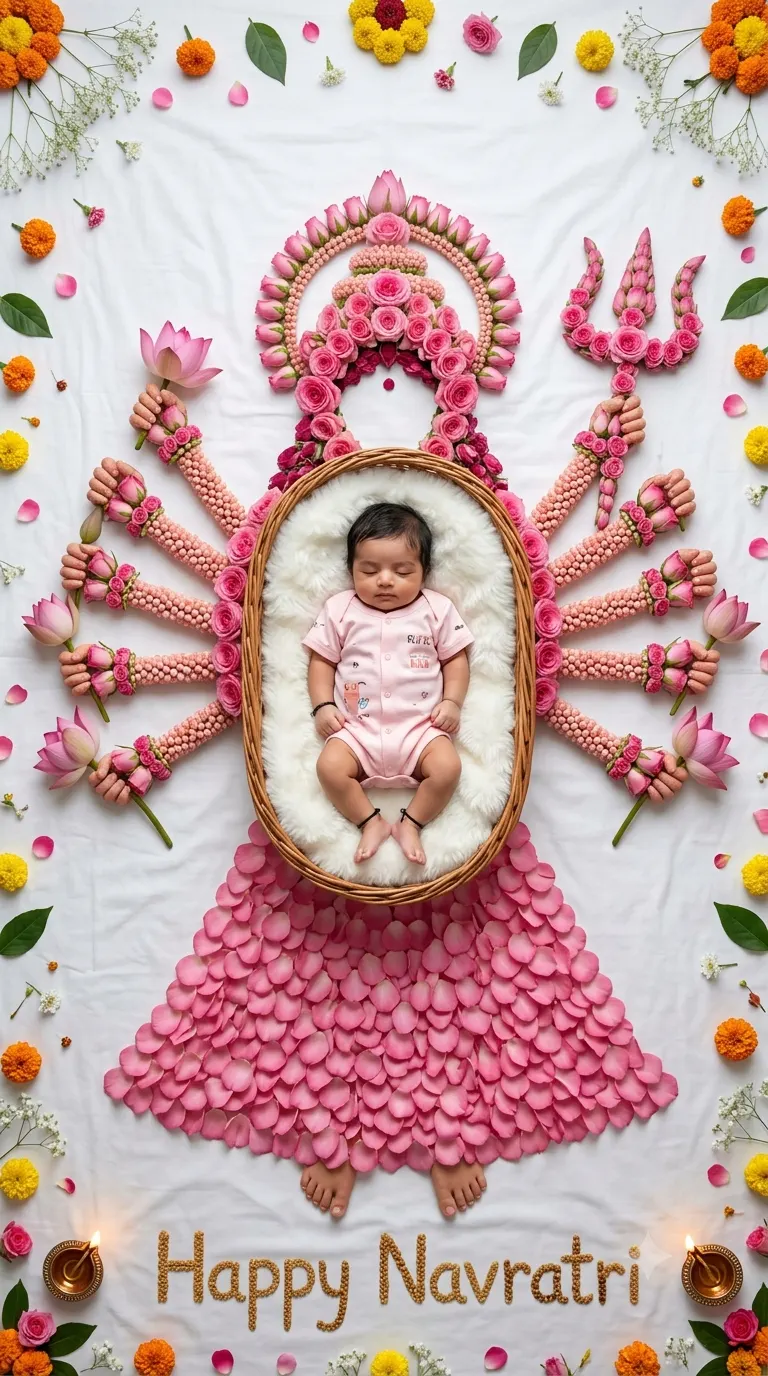
Create Image — Navratri Baby Photoshoot With Floral Maa Durga Formation
Use the uploaded reference image exclusively as the facial identity source for the baby. Directly copy the exact facial identity of the baby from the uploaded image into the generated image, including the exact head shape, forehead, hairline, eyebrow structure, eyelids, eye shape and spacing, iris appearance, nose, lips, cheeks, chin, ears, natural skin tone, skin texture, facial proportions, apparent age, and recognizable facial characteristics. Do not create a similar face, face inspired by the reference, or generic baby face. Do not beautify, reshape, enlarge the eyes, modify the nose, change the age, or stylize the facial features. The uploaded image is used only to copy the exact face identity; all other elements must be reconstructed from the visual reference.
Reconstruct the supplied image as a Navratri baby photoshoot in which the baby is placed in the center of a large handcrafted standing multi-armed Maa Durga composition. The most important visual idea is that Maa Durga is not a printed picture, illustration, statue, or digital graphic; the entire goddess formation is physically created on the white floor around the baby using real pink rose flowers, rosebuds, lotus petals, marigold flowers, flower garlands, green leaves, decorative beads, and other visible natural materials. The baby lies inside a vertically positioned oval wicker basket while the floral Durga arrangement radiates outward behind and around the basket, creating the visual impression of a standing multi-armed goddess whose body and arms are formed entirely from flowers and decorative materials.
Position the baby at the exact visual center of the composition, lying inside an upright oval-shaped natural brown wicker basket lined with thick fluffy white material. The basket forms the central body area of the composition, while the large Maa Durga floral artwork surrounds it from behind. Preserve the strong symmetrical arrangement: a floral crown and head shape above the basket, multiple arms extending diagonally outward on both sides, lotus flowers held at the ends of several hands, a prominent trident-shaped floral arrangement toward the upper-right, and a broad flowing skirt-like lower section made from hundreds of overlapping pink petals beneath the basket. The entire arrangement must read instantly as a standing multi-armed Maa Durga viewed from directly overhead.
Place the baby lying naturally on their back inside the wicker basket, centered on the fluffy white lining. Keep the baby’s head toward the upper portion of the basket and legs toward the lower portion. Both arms extend naturally outward toward the sides, with relaxed infant hands and slightly bent elbows. The legs remain naturally extended with the knees relaxed and bare feet visible. Preserve the innocent newborn/baby posture and natural infant proportions. Do not pose the baby like a standing goddess; the goddess is created entirely by the surrounding floral arrangement, while the baby remains naturally lying inside the basket.
Dress the baby in the same simple pale-pink baby outfit visible in the reference: a soft pink sleeveless or short-sleeved romper/overall-style garment over a light-colored inner shirt, with small colorful printed details on the front. Preserve the casual baby-photo styling rather than replacing it with a traditional goddess costume. Keep the clothing soft, comfortable, realistic, and appropriately sized for the baby. Add the subtle black ankle threads visible in the reference if clearly present. Do not add a crown, jewelry, heavy makeup, or traditional goddess clothing to the baby because the devotional goddess imagery is created by the surrounding flower arrangement.
Create the large standing multi-armed Maa Durga figure entirely from real flowers and physical decorative materials. The central upper portion should form a stylized goddess head and crown using densely arranged pink roses and rosebuds, with a large pink lotus-like floral crown at the top. Below and around this head, construct a broad floral body shape using layered pink petals. Extend multiple symmetrical arms outward from both sides using tightly arranged pink rosebuds, rose garlands, flower clusters, and bead-like floral elements. Each arm should end in a recognizable hand-like floral shape, with several hands holding or positioned beside natural lotus flowers. The arrangement should resemble a handcrafted floral rangoli or overhead flower installation rather than a painted goddess illustration.
Every major shape must be physically constructed from real flowers, petals, buds, leaves, seeds, beads, or other visible natural decorative materials. Use densely packed pink rosebuds for the arms and hand forms, large fresh pink lotus flowers for the symbolic flowers, overlapping pink rose petals for the flowing lower garment/body, orange and yellow marigolds around the perimeter, small green leaves for accents, and tiny white or pale dried flowers for delicate framing. Preserve visible individual petals, flower heads, stems, natural imperfections, overlapping layers, and realistic three-dimensional placement. Nothing in the Maa Durga design should look digitally painted, printed, embossed, or generated as a flat graphic.
Reconstruct the distinctive trident-shaped floral arrangement visible in the upper-right portion of the composition using tightly arranged pink flower buds and blossoms. Preserve its three-pronged silhouette and decorative structure. Include multiple lotus flowers around the goddess formation, including large open pink lotus blooms and smaller partially opened lotus buds. Add decorative floral garlands and bead-like arrangements around the sides. Preserve the small green leaves, scattered petals, orange marigold flowers, yellow flowers, and delicate white filler flowers distributed around the main formation.
Use a clean white fabric or seamless white floor covering as the entire base of the composition. The white surface should contain subtle natural wrinkles and fabric texture. Keep the complete arrangement laid physically on this surface. Around the perimeter, distribute orange and yellow marigold flowers, scattered pink petals, small green leaves, delicate white filler flowers, and tiny decorative elements in a balanced but natural manner. At the lower corners, include the two small traditional oil lamps/diya elements visible in the reference, positioned symmetrically. Do not introduce a temple, wall, outdoor scenery, furniture, or unrelated background.
At the bottom portion of the composition, reproduce the exact visible text “Happy Navratri”. The lettering should appear physically handcrafted from small golden-brown grains, beads, seeds, or tiny decorative particles laid individually on the white surface, matching the material-based aesthetic of the reference. Preserve the exact English wording, spelling, capitalization, and horizontal placement. Keep the text centered beneath the large pink floral lower section. Do not replace it with Hindi text, “Shubh Navratri,” “Happy Dussehra,” or any other wording. The letters must be clearly readable while visibly consisting of individually arranged physical decorative grains/beads rather than digital typography.
Use a directly overhead 90-degree top-down camera angle, looking straight down at the entire arrangement. The camera must be centered precisely over the baby and basket so the Maa Durga formation remains symmetrical around the vertical center axis. Capture the entire floral goddess design from crown to lower floral skirt, including the surrounding marigolds, diyas, scattered petals, and “Happy Navratri” text. Do not use an eye-level portrait angle, three-quarter angle, low angle, or perspective view.
Simulate a professional full-frame camera mounted directly overhead using approximately a 50mm lens with minimal distortion. Position the camera high enough to capture the entire handcrafted arrangement within the vertical 9:16 frame while maintaining enough detail to clearly distinguish individual petals, flowers, beads, basket fibers, and text materials. Keep the lens axis perfectly perpendicular to the floor. Avoid wide-angle stretching that would distort the oval basket or make the outer floral arms disproportionately large.
Use soft, broad, diffused overhead studio lighting that illuminates the entire white surface evenly. Maintain gentle natural shadows underneath the flowers, basket, petals, garlands, and baby so every physical layer remains distinguishable. Allow the pink flowers to retain their natural tonal variations and the orange and yellow marigolds to appear vibrant but realistic. The wicker basket should show detailed woven texture, while the white fabric should retain subtle folds. Avoid harsh directional shadows, dramatic colored lighting, artificial glow, or flattened lighting that removes the three-dimensional material quality.
Preserve the reference’s bright festive Navratri palette dominated by white, vibrant pink, rose-red, orange, yellow, natural green, warm brown wicker, and small golden accents. The overall mood should be joyful, devotional, delicate, celebratory, and handcrafted. Keep the white background bright and clean while allowing the floral Durga formation to provide the dominant color structure. Maintain natural flower colors rather than excessive digital saturation.
Create an ultra-realistic 4K Ultra HD professional overhead baby photoshoot photograph. Every flower, petal, rosebud, marigold, leaf, bead, wicker strand, fabric wrinkle, diya, and decorative grain must have realistic physical texture and natural imperfections. The basket must look genuinely woven from natural wicker. The baby must have realistic infant skin, natural hair, anatomically correct hands and feet, and believable contact with the fluffy basket lining. The floral Maa Durga formation must look like a real handcrafted installation photographed from above, not an AI-generated illustration.
Do not turn the Maa Durga formation into a printed image, painting, statue, digital illustration, transparent graphic, or conventional goddess photograph. Do not place an actual goddess figure behind the baby. Do not invent a different composition or change the standing multi-armed floral arrangement. Do not replace the flowers with colored fabric or generic decorative graphics. Do not change the baby’s natural lying position, basket, or pink outfit. Do not replace the exact “Happy Navratri” wording or guess additional text. Avoid incorrect flower shapes, missing arms, asymmetrical goddess formation, random floral placement, excessive decorations, temple architecture, extra people, artificial CGI flowers, plastic-looking petals, distorted baby anatomy, incorrect text, or unnecessary creative additions.
Generate one ultra-realistic 4K Ultra HD image in a strict vertical 9:16 aspect ratio, faithfully reconstructing the supplied reference as a Navratri baby photoshoot featuring a standing multi-armed Maa Durga formed entirely from real flowers and decorative natural materials around a baby lying inside a wicker basket. Preserve the direct copied baby facial identity, natural lying pose, pink outfit, oval wicker basket, white fluffy lining, symmetrical floral goddess formation, multiple flower-built arms and hands, lotus flowers, floral trident, pink petal skirt/body, marigolds, green leaves, diyas, scattered petals, and the exact physically constructed “Happy Navratri” lettering. The reference image remains the primary source of truth for composition, proportions, placement, materials, visual hierarchy, camera geometry, and overall appearance.
Explore more prompts related to this one.