Create Image — One Month Baby Milestone With Handcrafted Shivling Grain Art
- STRICT FACE IDENTITY COPY DNA
Use the uploaded reference image exclusively as the facial identity source for the baby. Directly copy the exact facial identity of the baby from the uploaded image into the generated image, including the exact head shape, forehead, hairline, eyebrows, eyelids, eye shape and spacing, iris appearance, nose, lips, cheeks, chin, ears, natural skin tone, skin texture, facial proportions, apparent age, and recognizable facial characteristics. Do not create a similar face, face inspired by the reference, or generic baby face. Do not beautify, reshape, enlarge the eyes, modify the nose, change the age, or stylize the facial features. The uploaded image is used only for exact facial identity copying; everything else must be reconstructed from the reference image.
- VISUAL RECONSTRUCTION DNA
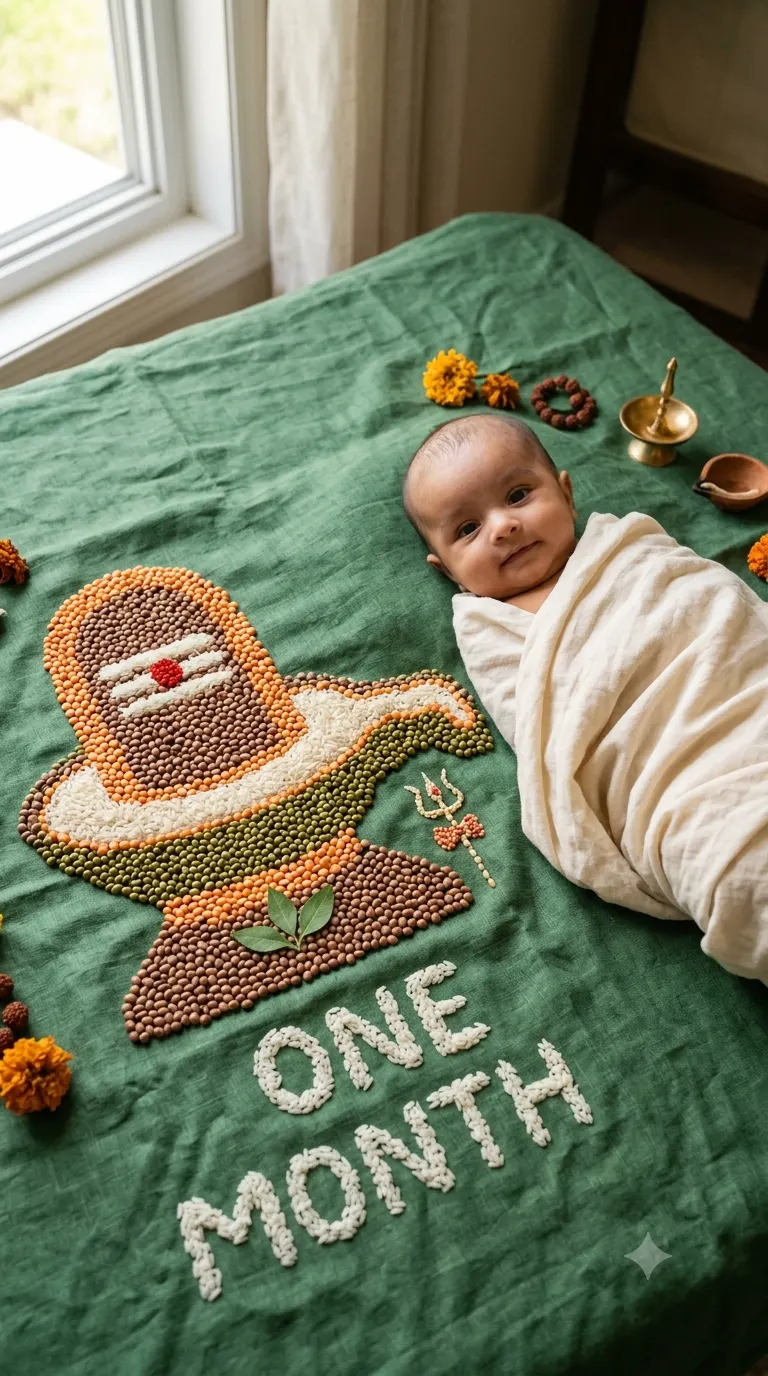
Reconstruct the reference as a one-month baby milestone photoshoot featuring a baby positioned beside a large handcrafted Shivling-inspired grain artwork. The dominant visual idea is the physical construction of the devotional form from densely arranged tiny white grains or rice-like material on a dark green fabric background. The baby is positioned on the right side, facing the handcrafted Shivling on the left, creating an intimate side-facing interaction. The composition also includes a small traditional damru near the baby, white flowers and green leaves around the lower portion, and the milestone text “ONE MONTH” formed from white grains.
- SUBJECT & COMPOSITION DNA
Place the baby on the right half of the vertical composition, standing or supported upright beside the large grain-art Shivling. Place the Shivling prominently on the left half and make it substantially larger than the baby. Preserve the visual relationship between the two subjects: the baby’s face and hands are oriented toward the Shivling, while the Shivling remains the primary decorative structure. Position the milestone text horizontally across the lower-middle portion beneath the main subjects, with floral decoration below it. Maintain the dark green negative space surrounding the arrangement.
- POSE & BODY LANGUAGE DNA
Reproduce the baby in a natural upright side-facing pose, with the baby’s body oriented toward the Shivling. The baby’s head is turned toward the left, with the face close to the devotional form. One arm is bent forward with the hand positioned near the face, while the other hand is also raised naturally in front of the body. Preserve the baby’s relaxed infant posture, slightly curved back, naturally bent legs, bare feet, and authentic newborn body proportions. Do not make the baby pose like an adult or deliberately imitate a formal devotional posture.
- OUTFIT & STYLING DNA
Reconstruct the baby wearing a simple mustard-yellow/orange traditional cloth wrapped around the lower body, leaving the upper body naturally bare as visible in the reference. Preserve the loose, soft folds of the fabric and its slightly irregular hand-wrapped appearance. Do not add a shirt, modern clothing, jewelry, crown, or additional costume elements that are not visible in the reference. Keep the styling simple so the handcrafted Shivling remains visually dominant.
- SHIVLING GRAIN-ART DNA
Reconstruct the large Shivling-like devotional form on the left using densely packed small white grains or rice-like natural particles. The central rounded vertical Shivling rises from a broad layered circular base, with the surrounding yoni-like platform extending toward the right. Preserve the thick, textured three-dimensional appearance created by thousands of closely arranged white grains. The entire structure should look physically assembled grain-by-grain directly on the dark green fabric, with individual grains visibly distinguishable rather than appearing as smooth plaster, clay, plastic, or a digitally rendered object.
- SHIVLING DETAILS & MATERIAL DNA
Preserve the visible horizontal decorative markings across the front of the upper Shivling section using pale grain material, with a small red circular element centered between the markings. Preserve the green leaf arrangement placed on the lower front section of the base. Keep the layered circular base clearly defined through stacked rings of white grain material. The edges should remain naturally irregular, showing the handcrafted construction rather than mathematically perfect digital geometry.
- PROPS & FLORAL DECORATION DNA
Include the small traditional damru visible beside the baby toward the right side of the Shivling, positioned around the baby’s upper-body level. Reconstruct it as a physical miniature drum with a wooden or warm-colored central body and crisscrossed cord/string detailing. Around the lower-left and lower-center portions, place small white five-petaled flowers and fresh green leaves exactly in the decorative style visible in the reference. Keep the floral elements sparse and naturally scattered rather than filling the entire background.
- BACKGROUND DNA
Use a deep dark forest-green fabric as the entire background and floor surface. Preserve the visible soft folds, wrinkles, and uneven fabric texture. The dark green surface should provide strong contrast against the white grain artwork, white flowers, and pale milestone lettering. Do not replace the fabric with a studio wall, wooden floor, temple background, outdoor scenery, or another colored backdrop.
- TEXT & TYPOGRAPHY DNA
Reproduce the exact visible milestone text “ONE MONTH” in uppercase English. The words must be physically constructed from individually arranged small white grains or rice-like particles, matching the material used for the Shivling artwork. Place the text horizontally across the lower portion of the image beneath the baby and Shivling. Preserve the exact spelling, capitalization, spacing, and two-word wording. The letters should have an organic handcrafted texture with visible individual grains and slightly irregular edges. Do not use digital typography, smooth printed lettering, Hindi text, “1 MONTH,” “ONE MONTH OLD,” or any additional wording.
- CAMERA DNA
Use a straight-on, slightly elevated baby-portrait camera angle that captures the baby and Shivling from approximately the same frontal side perspective as the reference. Keep the camera sufficiently far away to include the entire Shivling, complete baby body, milestone text, flowers, leaves, and surrounding dark-green fabric. Preserve the strong vertical composition and the left-right relationship between the Shivling and baby. Do not use an overhead flat-lay angle because the reference is photographed from the side/front.
- LENS & CAMERA DISTANCE DNA
Simulate a professional full-frame camera using approximately a 50mm portrait lens positioned around 2.5–3 metres from the subjects. Maintain natural baby proportions and avoid wide-angle distortion. Use approximately f/4–f/5.6, keeping the baby and main grain artwork sharply detailed while allowing the distant fabric background to remain subtly softer. Preserve enough depth of field for the “ONE MONTH” lettering and floral decorations to remain readable and recognizable.
- LIGHTING DNA
Use soft, diffused frontal lighting with gentle illumination falling across the baby’s face, bare skin, yellow cloth, white grain artwork, and flowers. Maintain subtle dimensional shadows between the layers of the grain Shivling so its physical construction remains visible. The dark green fabric should remain deep and rich without becoming completely black. Avoid harsh flash, dramatic colored lighting, excessive glow, or theatrical illumination.
- COLOR GRADING & MOOD DNA
Preserve the reference palette of deep forest green, warm white, natural baby skin tones, mustard yellow/orange cloth, small red accent, fresh green leaves, and white flowers. The mood should feel peaceful, innocent, devotional, handcrafted, and intimate. Keep the colors realistic and moderately saturated. Do not introduce neon colors, cinematic teal-orange grading, excessive HDR, or artificial color effects.
- IMAGE QUALITY DNA
Create an ultra-realistic 4K Ultra HD professional baby milestone photograph. Show realistic infant skin texture, fine baby hair, natural fabric folds, authentic grain surfaces, individual rice/grain particles, woven-looking background fabric, realistic flower petals, natural leaves, and physically believable damru construction. The Shivling and lettering must clearly look handcrafted from thousands of individually placed grains rather than computer-generated smooth shapes.
- NEGATIVE / EXCLUSION DNA
Do not change the copied facial identity. Do not replace the baby with a generic infant. Do not turn the Shivling into a stone statue, metallic object, painted illustration, digital graphic, or smooth sculpture. Do not replace the white grain material with flowers unless the reference visibly contains flowers in that particular element. Do not remove the layered Shivling base, horizontal markings, red central detail, green leaves, damru, white flowers, or grain-built lettering. Do not change “ONE MONTH” into different text. Avoid extra people, temple architecture, religious statues, excessive decorations, modern props, malformed baby anatomy, unnatural limbs, artificial skin, smooth CGI grains, incorrect text, and creative redesign of the reference.
- OUTPUT DNA
Generate one ultra-realistic 4K Ultra HD image in a strict vertical 9:16 aspect ratio, faithfully reconstructing the supplied reference as a one-month baby milestone photoshoot. Preserve the directly copied baby facial identity, natural upright side-facing pose, mustard-yellow/orange lower-body cloth, large handcrafted white-grain Shivling with layered base and visible decorative details, miniature damru, white flowers, green leaves, deep forest-green wrinkled fabric background, and the exact physically constructed “ONE MONTH” lettering made from white grains. The reference image remains the primary source of truth for composition, proportions, materials, placement, camera geometry, lighting, and overall visual appearance.